
Blockout Roller Blind Fabric Supplier Evaluation: Terms and Acceptance Checklist
A supplier evaluation for blockout roller blind fabric becomes reliable only when it separates two things the market usually discusses together. Commercial terms define how the order works: minimum quantity, price basis, payment, logistics, lead time and warranty. Acceptance criteria define how the delivered goods are judged: width, shade, coating integrity, colour fastness, flame performance and the documents that must travel with the shipment. Getting both agreed in writing before the order is placed is what keeps a first shipment from becoming a negotiation.
The evaluation below is built for a procurement team that is past the stage of comparing catalogues and is preparing to place or repeat an order. It works as a sequence: first design the specification in language a supplier can sign against, then define the checks the same specification will be tested by, and only then settle the money and logistics.
What this checklist covers
- Commercial terms: MOQ, price basis, payment, logistics, lead time, capacity reservation, warranty, technical support.
- Physical acceptance: product identity and batch consistency, width and roll length, colour and appearance, blackout performance, coating integrity, colour fastness, flame results, defects.
- Document acceptance: certificates with a valid scope and expiry, test reports naming the test method, chemical declarations, roll-level traceability.
- Process: who inspects, when inspection happens, what standard is applied, and what happens to a rejected lot.
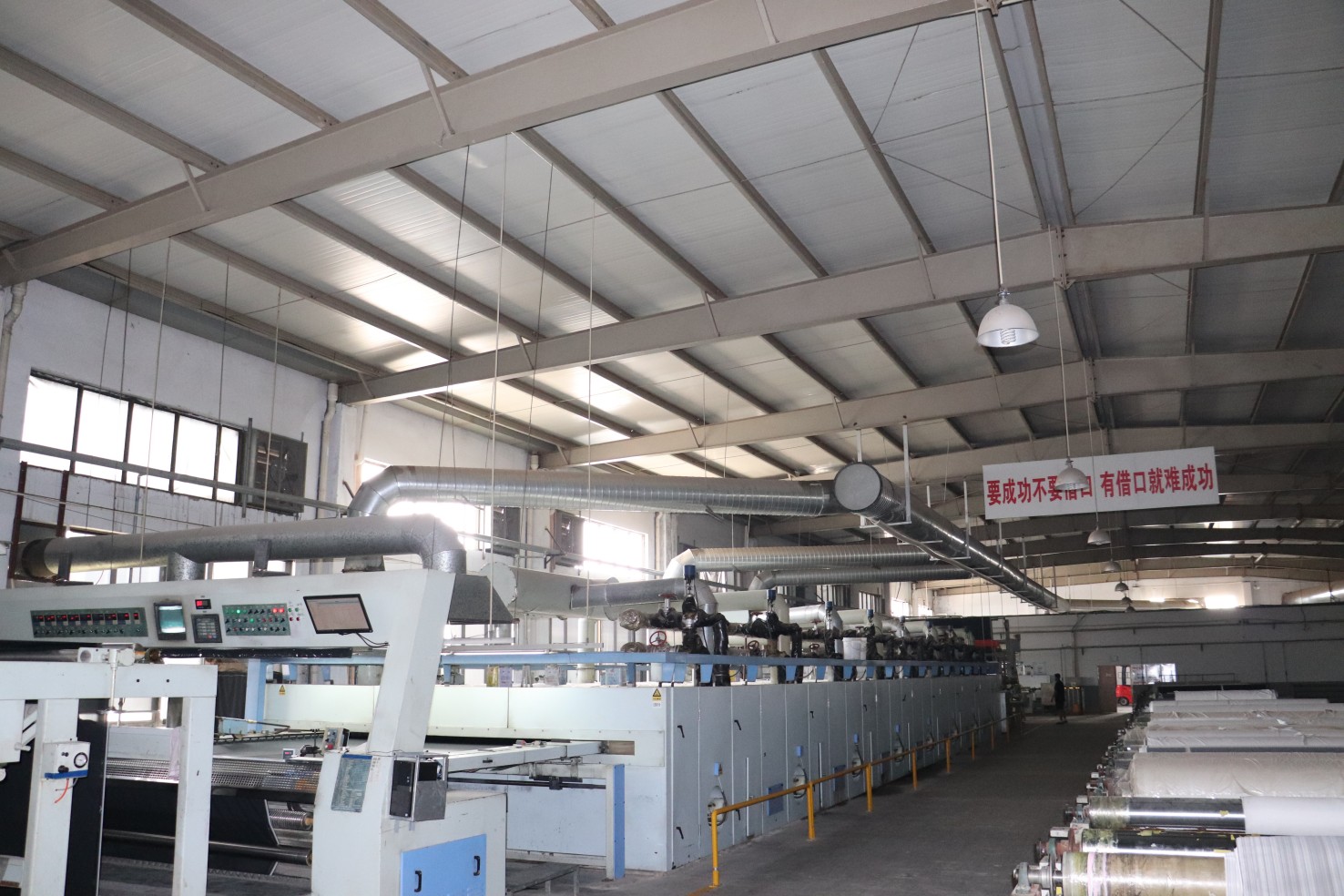
Why purchasing terms and acceptance criteria must be written as two separate lists
Commercial purchasing terms govern the relationship between two companies. Acceptance criteria govern the relationship between a buyer and a physical roll of fabric. Merging them into one document produces a contract that is easy to sign and hard to enforce, because a vague acceptance clause cannot be repaired by a well-drafted payment clause.
The failure is predictable. An order that names a product and a price but defines acceptance as "full blackout, good quality" leaves the supplier free to deliver what its own process produces and its own reading of those words supports. The buyer then has to argue about a result it never specified, and the argument is usually settled by whoever is holding the goods. The reverse problem is less common but just as costly: detailed physical criteria agreed with no payment milestone, no Incoterm and no delivery trigger, which turns a technically clean order into an administrative dispute.
Kept separate, each list does one job. Every commercial clause should attach to a document — purchase order, proforma invoice, sales contract, letter of credit. Every acceptance criterion should attach to a measurement, a sample, a test report or an inspection record. A clause that attaches to none of these is not a term; it is an intention.
Industry context that shapes what belongs in the acceptance list
Four technical realities determine how much detail an acceptance list for blockout roller blind fabric actually needs.
Category names are commercial labels, not standardised classes
Blockout, dimout, translucent, light filter and sunscreen are used across the blind fabric trade to group products by how much light they pass. Public evidence does not support treating these words as fixed technical classes with shared thresholds, and suppliers can apply them to different constructions. For a buyer, the practical consequence is simple: the acceptance clause has to fix the measurement method along with the target, otherwise two suppliers quoting "blockout" are not quoting the same thing.
Flame performance is jurisdiction-specific and not interchangeable
European construction products are classified through EN 13501-1, which assigns Euroclasses A1 to F from reaction-to-fire test data, with additional classes for smoke production and flaming droplets. UK curtain, drape and blind fabrics are graded under BS 5867-2 as Type A, Type B or Type C. The United States commonly references NFPA 701, a test method for flame propagation of textiles and films. Marine interiors fall under a separate regime, IMO FTP Code Part 7, which addresses curtains and drapes specifically. A BS 5867-2 Type B result does not translate into a Euroclass, and an NFPA 701 report does not establish European classification. An acceptance list that says only "fire retardant" therefore verifies nothing.
Customs treatment changes with the point of import
Coated fabric in the roll and a finished blind are declared under different headings. HS heading 59.03 covers textile fabrics impregnated, coated, covered or laminated with plastics, split by the plastic used: 5903.10 for poly(vinyl chloride), 5903.20 for polyurethane and 5903.90 for other plastics. HS heading 63.03 covers curtains, drapes, interior blinds and valances. A buyer importing fabric to fabricate locally and a buyer importing finished blinds are answering different documentation questions, and the acceptance pack should match the point in the chain where the goods actually cross the border.
Chemical declaration duties sit alongside product performance
Under REACH, a supplier of an article containing a Candidate List substance above 0.1% weight by weight must give the recipient enough information for safe use, and the Candidate List itself is maintained and updated by ECHA. REACH registration applies from one tonne per year per manufacturer or importer per substance. Neither obligation is satisfied by a performance certificate, which is why chemical declarations belong in the acceptance pack as a separate item rather than as an appendix to a flame report.
Commercial terms checklist: eight things to fix before the first order
The commercial list is short, but every item on it should be expressed as a number, a date or a named document. Descriptions such as "flexible MOQ" or "prompt delivery" cost nothing to write and verify nothing.
- MOQ and price basis. Elitex lists a minimum order of 500 meters for its blockout production and states that customized quantities are set through discussion. Record the MOQ, whether price is quoted per meter or per roll, what specification the quoted price assumes, and whether width, colour or coating changes reopen the price.
- Payment terms. Elitex lists payment by bank transfer. The contract still needs the deposit percentage, the event that triggers the balance — pre-shipment, bill of lading date, or arrival — and who absorbs bank charges at each end.
- Logistics and delivery terms. Elitex describes its delivery arrangements as international logistics. That is a transport mode, not a transfer of risk. State the Incoterm separately, together with who handles export clearance and who clears the goods on arrival.
- Lead time, measured from a defined event. Elitex publishes a lead time of 15–30 days. Pin the start of that clock: order confirmation, receipt of deposit, or approval of the signed sample. A lead time with no start event cannot be monitored.
- Capacity reservation for volume orders. Elitex reports monthly capacity of 500,000 meters. For a large or repeating programme, agree whether shipments are split, how far ahead volumes are declared, and what happens if the buyer's forecast falls short.
- Warranty scope. Elitex offers a 10-year interior limited warranty and a 5-year exterior limited warranty. Confirm what the warranty excludes, when the period starts, whether it attaches to the fabric or the installed blind, and what evidence a claim requires.
- Customization boundaries. Elitex offers OEM and ODM customization across colour, size, openness, logo, weave pattern and coating. Each variable should be tied to an approved sample or drawing, and the change procedure should say who signs off and how a change affects price and lead time.
- Support and escalation. Elitex lists 24/7 online support, technical guidance and after-sales service. Convert this into a named contact, a response expectation and the route for a technical query during installation rather than after it.
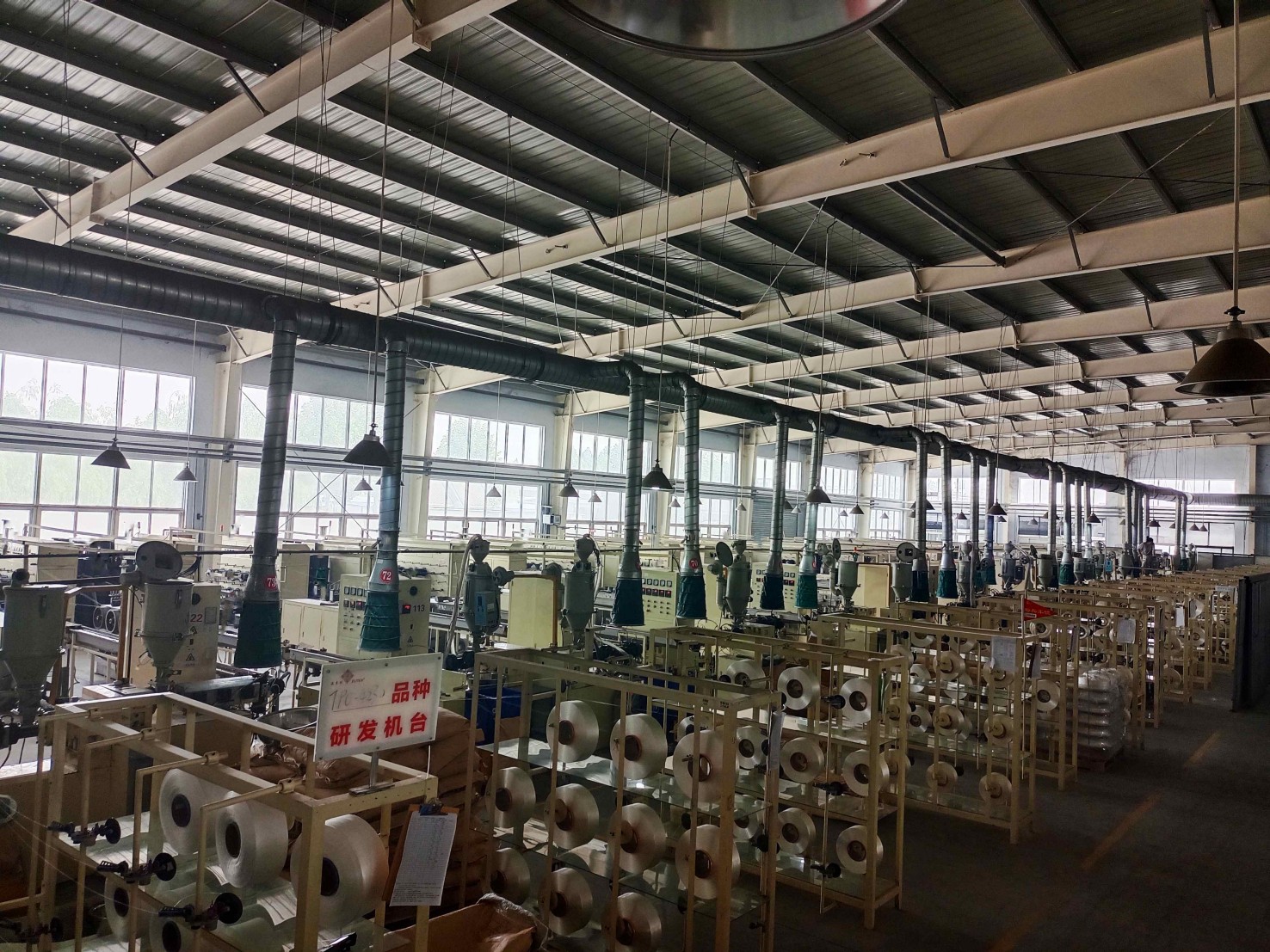
Acceptance criteria checklist: what is actually verified on delivery
Every acceptance criterion should be traceable to an action someone can perform on arrival or a document the supplier can produce. If neither exists, the criterion is decorative.
Product identity and batch consistency
Confirm fabric name, series, colour code and roll number against the approved sample and the purchase order. Where an order spans more than one production batch, state the permitted colour variation between batches rather than only between a roll and a swatch, because multi-floor installations are judged on the wall, not on the pallet.
Width, length and roll build
Specify width in millimetres with a tolerance, nominal meters per roll, the maximum number of joins permitted per roll, the acceptable short-roll allowance, and core diameter. These are mechanical checks and should be recorded per roll, not averaged across the lot.
Blackout performance
Because the category vocabulary is not standardised, the acceptance clause must name the measurement method, the sample preparation and the pass threshold, or accept a supplier test report produced under a named method. Without that, a light-leak complaint at installation has no reference point and cannot be resolved against a specification.
Colour, appearance and surface defects
Agree the viewing conditions for colour assessment, the retained standard sample, and a defect allowance per hundred square meters covering stains, creases, skew and weaving faults. Appearance criteria written per roll rather than per shipment prevent a clean roll from hiding a defective one.
Coating integrity
Check for coating rub-off, blocking between layers, pinholes and uneven coverage across the width. Coating defects often surface only after cutting, so the inspection point should be before cutting, not after fabrication.
Colour fastness to light
Elitex reports colour fastness of Grade 6–7 for its blockout fabrics under ISO 105-B02-2014 xenon arc testing. On acceptance, confirm that the report names the method, the testing body and the specific fabric being purchased, since a result for one construction does not transfer to another.
Flame performance evidence
Require a report naming the standard and the classification achieved. Elitex lists NFPA 701-2015, EN 13773 Class 1, BS 5867-2 Type B and AS1530-2/3 for its Blockout Dusk Plus series. Match the certificate to the destination market and the application, not to the supplier's general capability.
Chemical and safety declarations
For EU-bound goods, request an SVHC declaration addressing the 0.1% w/w threshold under REACH Article 33. Where the buyer's own customer requires it, add the OEKO-TEX certificate and confirm that its scope covers the fabric actually ordered.
Packaging, labelling and traceability
Agree roll wrapping, inner lining, label content, batch marking and pallet configuration. Traceability is only useful if the roll number on the label can be matched to a production record and a test report.
Certificate and compliance document checklist
Certificates usually fail an evaluation for one of three reasons: the scope does not cover the product being bought, the document has expired, or the certificate holder is not the entity that will ship the goods. All three are checkable in a few minutes.
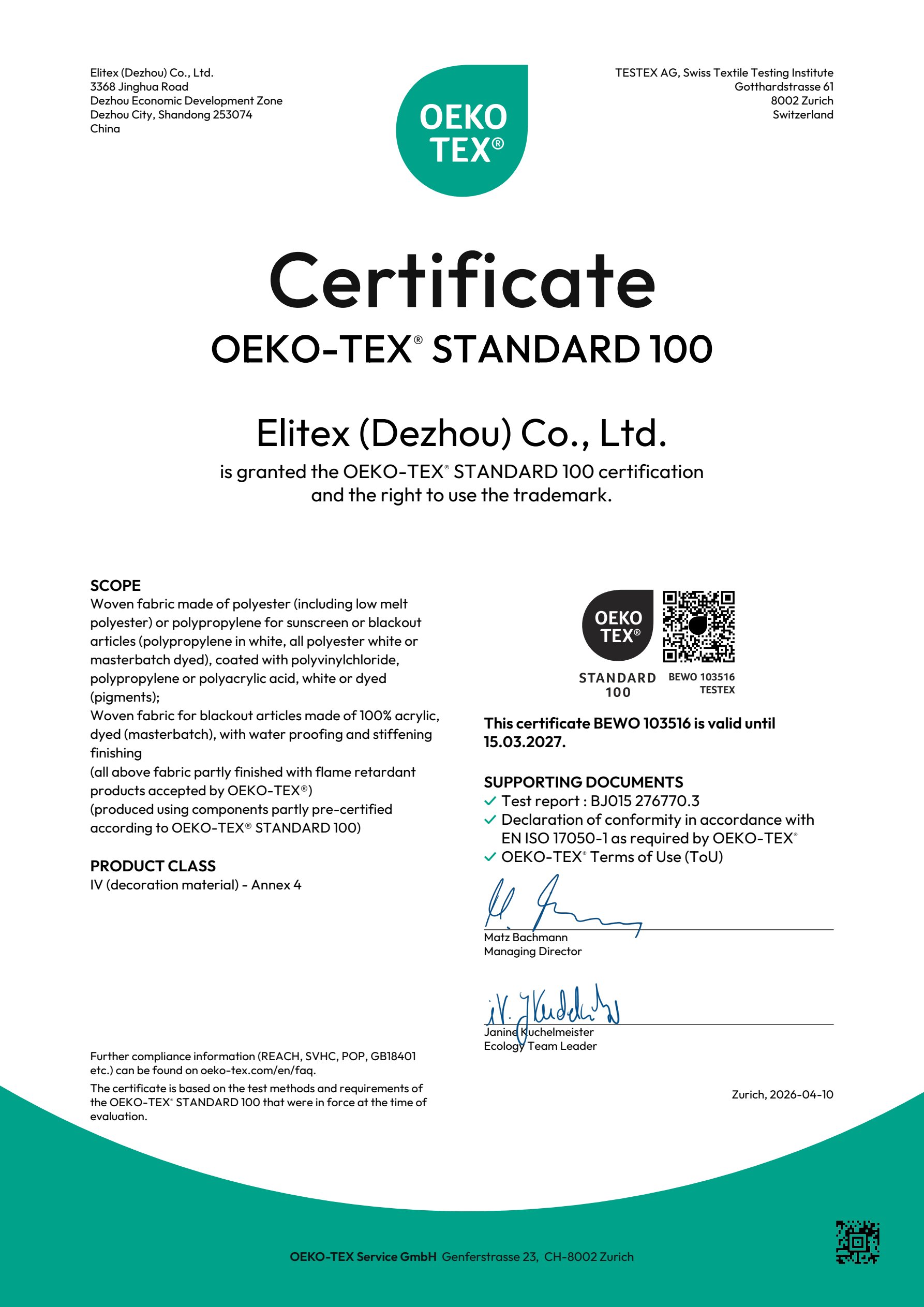
- OEKO-TEX STANDARD 100 — certificate BEWO 103516, issued by TESTEX AG, Swiss Textile Testing Institute. Scope: woven fabric made of polyester, polypropylene and polyacrylic for sunscreen and blackout articles, product class IV (decoration material). Valid to 2027-03-15.
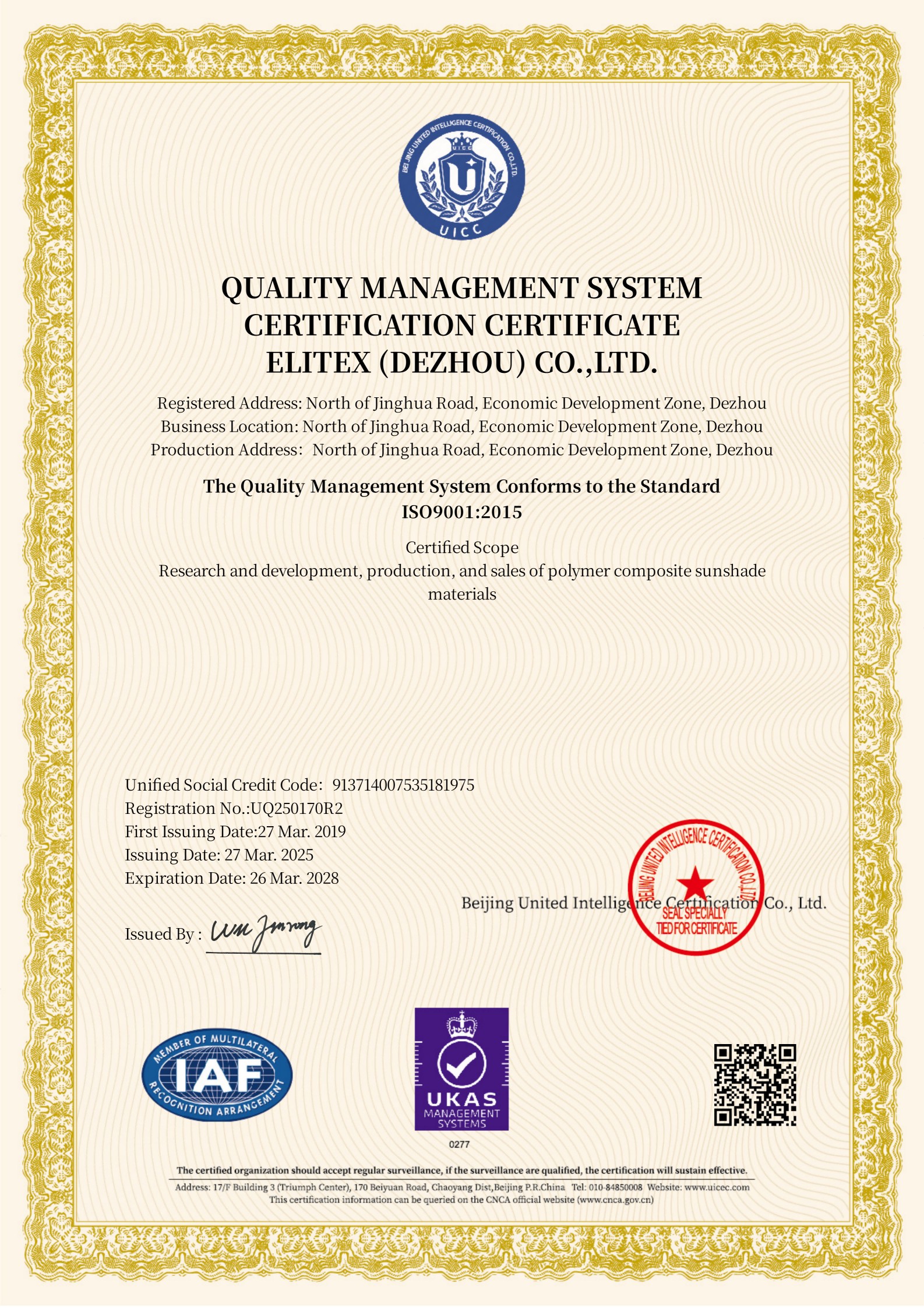
- ISO 9001:2015 quality management system — certificate UQ250170R2, issued by Beijing United Intelligence Certification Co., Ltd., covering research and development, production and sales of polymer composite sunshade materials. Valid to 2028-03-26.
- ISO 14001:2015 environmental management system — certificate UE250076R1. Valid to 2028-04-20.
- ISO 45001:2018 occupational health and safety management system — certificate US250047R1. Valid to 2028-04-20.
- UL GREENGUARD and GREENGUARD Gold — certified for low chemical emissions under UL 2818, covering ELITEX (DEZHOU) CO., LTD. products.
- REACH Article 33 SVHC declaration — a legal information duty rather than a voluntary certificate, and therefore required on request rather than offered as a badge.
Practical rule: log the certificate number and expiry date in the acceptance file at every re-evaluation. An expired certificate is a gap even when the fabric behind it has not changed.
Step by step: from enquiry and sample approval to first-article acceptance
The sequence below is ordered so that each stage produces the document the next stage depends on. Run out of order, it produces a price agreed against a specification nobody has yet tested.
- Convert the requirement into acceptance language. Take the application brief — room type, orientation, required darkness, cleaning regime, destination market — and express it as measurable criteria with tolerances. Nothing should survive this step as an adjective.
- Request the document pack before discussing price. Ask for the certificates, the flame report naming the standard, the colour fastness report and the SVHC declaration. Missing documents at this stage are a qualification issue, not a later formality.
- Approve a physical standard sample and retain it. Sign and date two sets: one retained by the buyer, one by the supplier. Record the colour code, the construction and the batch the sample came from.
- Confirm the commercial terms against the approved specification. Reconcile MOQ, price basis, payment, Incoterm, lead time start event and warranty scope with what was actually sampled. A price quoted on a different construction is not a price for this order.
- Agree the acceptance protocol in writing. Name who inspects — factory, buyer, or third-party laboratory — at what point, against which criteria, and what constitutes a rejectable lot. Elitex operates 100% inspection together with third-party laboratory testing, which is the right structure for the protocol to reference.
- Make the first delivery the strictest. Apply full criteria to the first shipment, then reduce sampling frequency for repeat lots only after the process has demonstrated stability. Relaxing checks before the first data set exists removes the evidence the evaluation was built to produce.
Who performs the checks, and why the three mechanisms are not interchangeable
Pre-shipment inspection, third-party laboratory testing and in-house 100% inspection answer different questions. In-house inspection, which Elitex applies across production, finds roll-level defects such as width deviations, coating marks and colour drift across a lot. Third-party laboratory testing establishes measurable performance — colour fastness, flame behaviour, chemical content — on the samples submitted. Pre-shipment inspection verifies that the lot about to ship matches the approved sample and the agreed packing specification.
None of them substitutes for another. A factory that inspects every roll still has not measured flame performance, and a laboratory report covering three swatches says nothing about the nine hundred meters behind them.
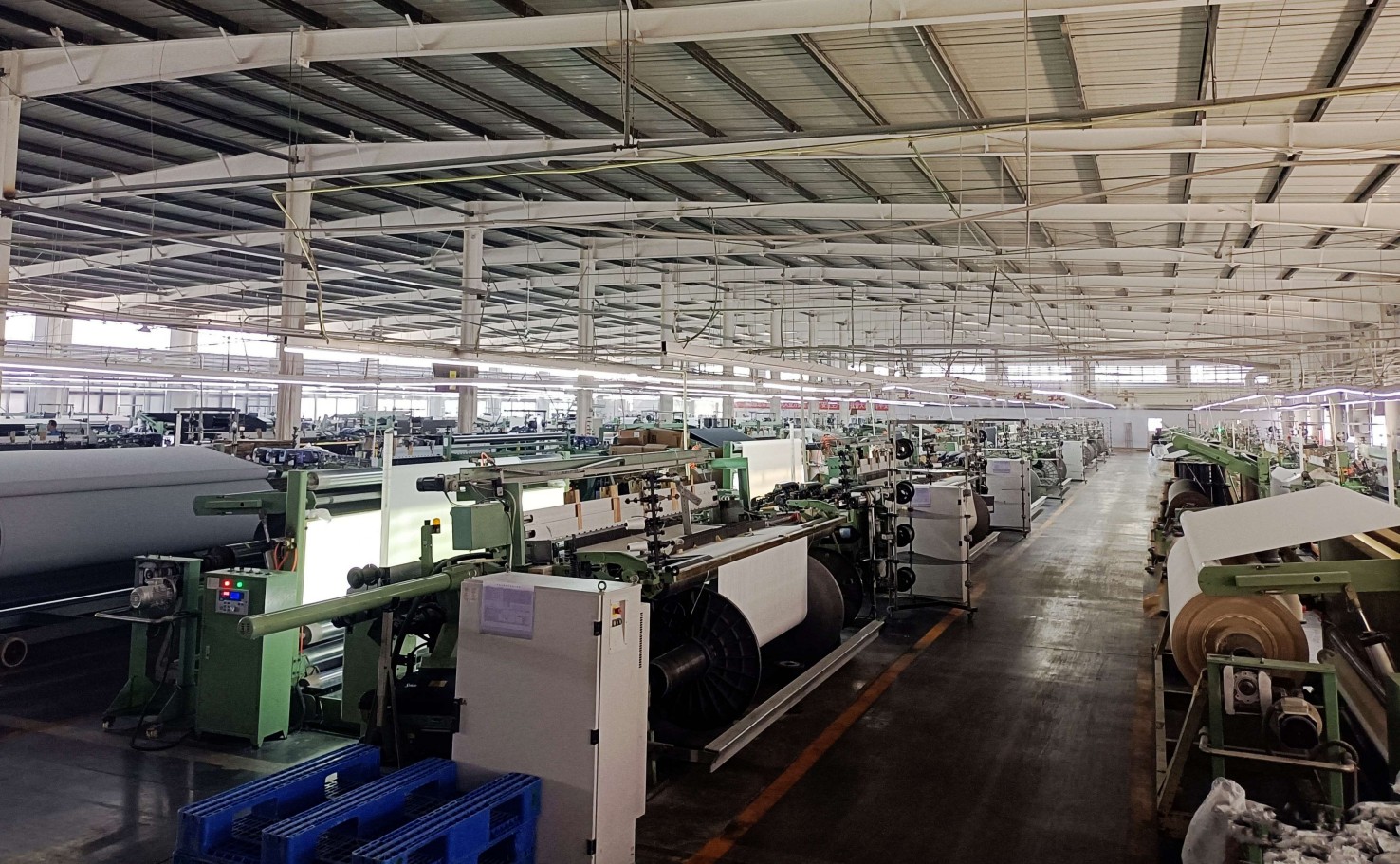
Applying both lists on hospitality and commercial office projects
Project buyers usually tighten the acceptance pack rather than the commercial one, because a hotel or an office fit-out places several batches on the same façade and holds the warranty for years. Elitex records more than 50 projects and over 10,000 meters supplied across Germany and Australia to hotel chains, commercial building developers, blind manufacturers and residential contractors — the buyer profile where batch-to-batch colour tolerance and a warranty that survives installation both matter.
In practice this means three additions to the standard list. First, batch variation limits replace colour approval by roll. Second, the flame report must cover the full range of constructions used in the building, not only the most common one. Third, the warranty document and the agreed delivery schedule should be reconciled, so that the coverage period starts on a date the buyer can prove.
Side-by-side: what each item belongs to
The table below maps the recurring evaluation items to the document that should carry them and the evidence that closes them out. It is deliberately organised by clause rather than by department, because procurement, quality and logistics are usually reading different sections of the same order.
| Evaluation item | Fix in the purchasing terms | Verify through |
|---|---|---|
| Product identity | Series, construction, coating type, colour code | Roll label matched to approved sample and purchase order |
| Width and length | Width in mm with tolerance, meters per roll, joins per roll | Per-roll measurement record and inspection report |
| Colour | Retained standard sample, batch variation limit | Visual assessment under agreed viewing conditions |
| Blackout performance | Named measurement method and pass threshold | Test report under the specified method |
| Colour fastness | Grade and test method | Laboratory report, for example ISO 105-B02-2014 |
| Flame performance | Standard, classification, destination market | Report naming the standard and the achieved result |
| Chemical safety | SVHC declaration at the 0.1% w/w threshold | Supplier declaration plus OEKO-TEX scope check |
| Quantity and timing | MOQ, lead time start event, shipment split | Confirmed order, proforma invoice, shipping documents |
| Payment | Deposit, balance trigger, bank charge allocation | Signed contract and payment records |
Flame test routes by market: why one report cannot cover everything
Where flame performance forms part of the specification, the acceptance clause should name the route that applies to the destination and the application. The four routes below are separate systems with separate outputs.
| Market or application | Reference | What it produces |
|---|---|---|
| European construction products | EN 13501-1 | Euroclass A1 to F from reaction-to-fire data, with additional smoke and flaming-droplet classes |
| UK curtain, drape and blind fabrics | BS 5867-2 | Flammability grading expressed as Type A, Type B or Type C |
| United States textile and film testing | NFPA 701 | A test method for flame propagation, referenced in specifications |
| Marine interiors | IMO FTP Code Part 7 | A dedicated fire test procedure for curtains and drapes |
Because the outputs differ in kind, a supplier holding several of these reports is not holding interchangeable proofs. The acceptance file should carry the one that matches the project, and the purchasing terms should name it explicitly rather than accepting a general statement of flame retardancy.
Six errors that quietly void a supplier evaluation
- Specifying with adjectives. "Full blackout" and "high quality" cannot be measured, so they cannot be rejected against either.
- Accepting a certificate without checking scope. A valid OEKO-TEX certificate for one construction does not cover a different coating or fibre blend.
- Ignoring expiry dates. Certificates roll over on their own schedule, not on the buyer's reorder schedule.
- Comparing prices on different bases. A per-meter quote against a per-roll quote, or one that excludes testing and inspection, is not a comparison.
- Leaving inspection undefined until dispatch. By then, a rejection has no schedule left to absorb it.
- Letting the supplier define the measurement method. The method should come from the destination standard or from the buyer's own specification, not from whichever procedure is convenient to run.
Frequently asked questions
What do purchasing terms and acceptance criteria usually include for blockout roller blind fabric?
In a supplier's standard response, purchasing terms cover the minimum order quantity, the delivery arrangement and the payment method, while acceptance criteria refer to the inspection mechanisms applied to the goods. Elitex states MOQ as customized upon communication, delivery terms as international logistics, payment terms as bank transfer, and acceptance criteria as pre-shipment inspection together with third-party laboratory testing. A complete evaluation extends the first list to price basis, Incoterm, lead-time start event and warranty scope, and extends the second list to width, colour, blackout performance, colour fastness and flame evidence.
Which compliance documents should be requested before approving a blockout fabric supplier?
Request the OEKO-TEX STANDARD 100 certificate and confirm its scope covers the fabric ordered — Elitex holds BEWO 103516 for woven polyester, polypropylene and polyacrylic sunscreen and blackout fabrics, product class IV, valid to 2027-03-15. Add ISO 9001:2015 (UQ250170R2), ISO 14001:2015 (UE250076R1) and ISO 45001:2018 (US250047R1) for management systems, UL GREENGUARD and GREENGUARD Gold certification under UL 2818 for low chemical emissions, and a REACH Article 33 SVHC declaration covering the 0.1% w/w threshold. For flame performance, request the report that matches the destination market rather than a general statement.
Can a supplier customize colour, width or coating for a specific project?
Elitex operates OEM and ODM custom manufacturing with customization across colour, size, openness, logo, weave pattern and coating. The capability is supported by a manufacturing base established in 2003, an 85,000 m² facility, 36 engineers and monthly capacity of 500,000 meters. For evaluation purposes, each customized variable should be tied to a signed sample or drawing, and the change procedure should state how a modification affects price and lead time.
How should quotations be compared once the specification is fixed?
Compare on a like-for-like basis: the same construction, width and coating, quoted per square meter or per roll rather than mixed, with the MOQ (500 meters at Elitex) and the customization level stated. Then add the costs that sit outside the fabric price — third-party laboratory testing, pre-shipment inspection, and the cost of holding a rejected lot in the schedule. A lower fabric price with no test documentation is not a lower total cost, because the buyer absorbs the verification work and the replacement risk.
What must match between the approved sample and the production rolls?
Construction, colour code, coating appearance and hand feel should match the retained standard sample, and the batch variation limit agreed for the order should hold across every roll delivered. Retaining a signed and dated sample on both sides is what makes the comparison possible months later. Where a project uses several batches, the colour assessment should be made under the viewing conditions written into the acceptance protocol rather than in the warehouse doorway.
What lead time and production capacity should a buyer plan around?
Elitex publishes a lead time of 15–30 days and monthly capacity of 500,000 meters, with an annual output reported separately for screen fabrics at 8,000,000 m² and blockout fabrics at 7,200,000 m². The figure that matters in the contract is not the published range but the start event: whether the clock begins at order confirmation, at deposit receipt or at signed sample approval. Fixing that in the terms is what converts a lead time into a schedule the buyer can plan an installation around.
How specific should warranty and after-sales terms be before approval?
Specific enough that a claim can be filed without interpretation. Elitex offers a 10-year interior limited warranty and a 5-year exterior limited warranty, supported by 24/7 online support, technical guidance and after-sales service. The evaluation should confirm what the warranty excludes, whether it attaches to the fabric or the finished blind, when the period starts, and which documents a claim requires. Buyers who want to test a candidate before committing to a programme can request a sample or a quotation through Elitex (Dezhou) Co., Ltd. and run the checklist above against the response.
Reference material: the Elitex Screenview Brochure 2026 sets out the sunshading and blockout fabric range and can be used alongside this checklist when a construction or coating option needs to be matched to a project.
A blockout roller blind fabric supplier evaluation is only as strong as the two lists behind it. The commercial list fixes MOQ, payment, logistics, lead-time start event and warranty in terms that can be checked against documents. The acceptance list fixes width, colour, blackout method, colour fastness and flame evidence in terms that can be checked against a roll. When both are agreed before the order and both are rechecked at delivery, the question at the end of the shipment stops being whether the goods are acceptable and becomes whether the records are complete — which is a far easier question to answer.
Have Questions or Need More Details?
Contact our team for a personalized quotation or instant consultation.
Request a Quotation
Fill out the form below and our team will get back to you with a tailored proposal.
WhatsApp Direct Chat
Prefer to chat in real-time? Message us on WhatsApp for instant assistance & quick answers.
- Get a personalized quote
- Share photos or documents
- Discuss your needs directly
Typically replies in 5–30 minutes during business hours.