
Blockout Fabric Compliance: A Buyer's Certification Map
Blockout Fabric Compliance: A Buyer's Certification Map
A blockout roller blind fabric is sold on light exclusion, but it is approved on documentation. This guide explains which standards typically appear in blockout fabric specifications across the EU, North America and Asia-Pacific, how to read the documents a supplier sends, and how to check a compliance claim against the evidence that sits behind it.
For importers, distributors and project buyers, the question that decides a purchase is rarely “does it block light?” It is: can this supplier prove, with a traceable document, that this exact construction is acceptable in the market and the building where it will be installed? Compliance failures seldom appear at the sample stage. They appear at customs, at the specifier's submittal review, or during a building inspection — after the roll has already been cut.
Elitex (Dezhou) Co., Ltd. manufactures sunshading and blockout fabrics for the international blind and awning industry, and exports roughly 80% of its output to the USA, EU, Australia, Southeast Asia and the Middle East. The reference construction used throughout this article is the Elitex Blockout Dusk Plus Series, a 100% polyester blockout roller blind fabric with an acrylic coating and 100% opacity with no pinholes.
The Compliance Problem: “Certified” Is Not a Specification
A compliance claim that does not name a standard, an edition year, a test method and a laboratory cannot be verified — and an unverifiable claim is not evidence of anything.
The reason this matters more for blockout fabrics than for single-material textiles is that blockout fabric is a composite. A base cloth carries a coating layer, an adhesive layer and, in some constructions, a metallic or foam backing. Each of those layers can change the way the finished roll behaves under a flame test or a chemical assessment. When any layer, weight or coating method changes, the article that was tested is no longer the article that is being shipped.
Three practical consequences follow, and buyers meet all three regularly:
- A certificate is not transferable by default. A document issued for one coating method or one fabric weight does not automatically cover a different knife-coated or paste-coated version of the same product family.
- A comfort classification is not fire evidence. Solar-shading performance standards describe thermal and visual comfort; they do not describe flame behaviour.
- Documentation follows the purchase order, not the sample. If the compliance requirement is not written into the order, the document set that arrives will usually be the supplier's standard one — which may not match the project.
Industry Background: Why Compliance Now Decides Market Access
Documentation expectations tend to follow demand. One published market analysis places the global blackout fabric market at approximately USD 10.5 billion in 2024, with a projection of USD 20.3 billion by 2034 (Vertex AI Search / Market Analysis 2025). Other published estimates differ sharply — around USD 2.7 billion in 2024 (Strategic Market Research) and around USD 11.0 billion in 2025 (IMARC Group). The gap reflects scope rather than disagreement about direction: some figures cover fabric only, others include finished blinds and window-treatment systems. Buyers who use market size in a business case should state which scope they are quoting.
Regional concentration is easier to read. Fortune Business Insights places North America at 50.70% of blinds and shades revenue in 2025, valued at USD 3.62 billion — a market where flame performance documentation is routinely requested for commercial interiors. On the material side, Future Market Insights estimates polyester at 47.2% of the blackout fabric laminate material segment in 2026, which matches the construction most compliance documentation is written around: a polyester base cloth with a coating layer. Coating technology also carries performance weight — advanced laminates with polyester and acrylic coatings can improve thermal heat resistance by 20–35% (Blackout Fabric Laminates Market Growth Report, 2025), which is one reason specifiers now ask for coating detail rather than a generic fabric description.
Against that backdrop, the global window-treatment manufacturing sector includes well-established players such as Hunter Douglas, Serge Ferrari Group and Edmund Bell (IMARC Group / Future Market Insights), alongside specialist Chinese manufacturers. For buyers, the practical shift is that compliance evidence has moved from a closing formality to a pre-qualification requirement.
The Regional Landscape: What Actually Applies
European Union: EN 14501:2021
The European standard most often written into solar shading specifications is EN 14501:2021, which specifies performance characteristics and classifications for solar protection devices — blinds and shutters — in relation to thermal and visual comfort (CEN, European Committee for Standardization). Two clarifications are worth keeping in mind. First, EN 14501:2021 is a performance classification, not a fire test; a classification value obtained under it should never be presented as evidence of flame behaviour. Second, the document that matters is not the standard number itself but the report showing which class the tested construction achieved, and under which edition.
North America: NFPA 701
In the United States, NFPA 701 is the mandatory flame propagation test for vertically hung textiles — including blackout curtains and blinds — used in public and commercial spaces (National Fire Protection Association). For a buyer, three details decide whether the report is useful: which edition of the test was applied, which laboratory issued the report, and whether the specimen described in the report is the construction actually being ordered. A report written around one weight or one coating method does not automatically extend to a heavier fabric or to a paste-coated rather than knife-coated construction.
Asia-Pacific, the Middle East and Other Markets
This guide's evidence set does not identify a single region-wide standard covering blockout fabrics across Asia-Pacific, the Middle East and other markets. Requirements are typically set at national level and then narrowed further by the project specification, the building type and the authority having jurisdiction. The practical instruction for buyers is therefore not to search for a regional equivalent, but to name the destination country on the purchase order and require the supplier to state which standard applies, which edition, and which laboratory performed the testing. Because Elitex supplies the USA, EU, Australia, Southeast Asia and the Middle East from one production base, a single production run may need documentation that satisfies more than one regime — a documentary question best settled before the order is placed, not after.
What the Factory Side Can Document
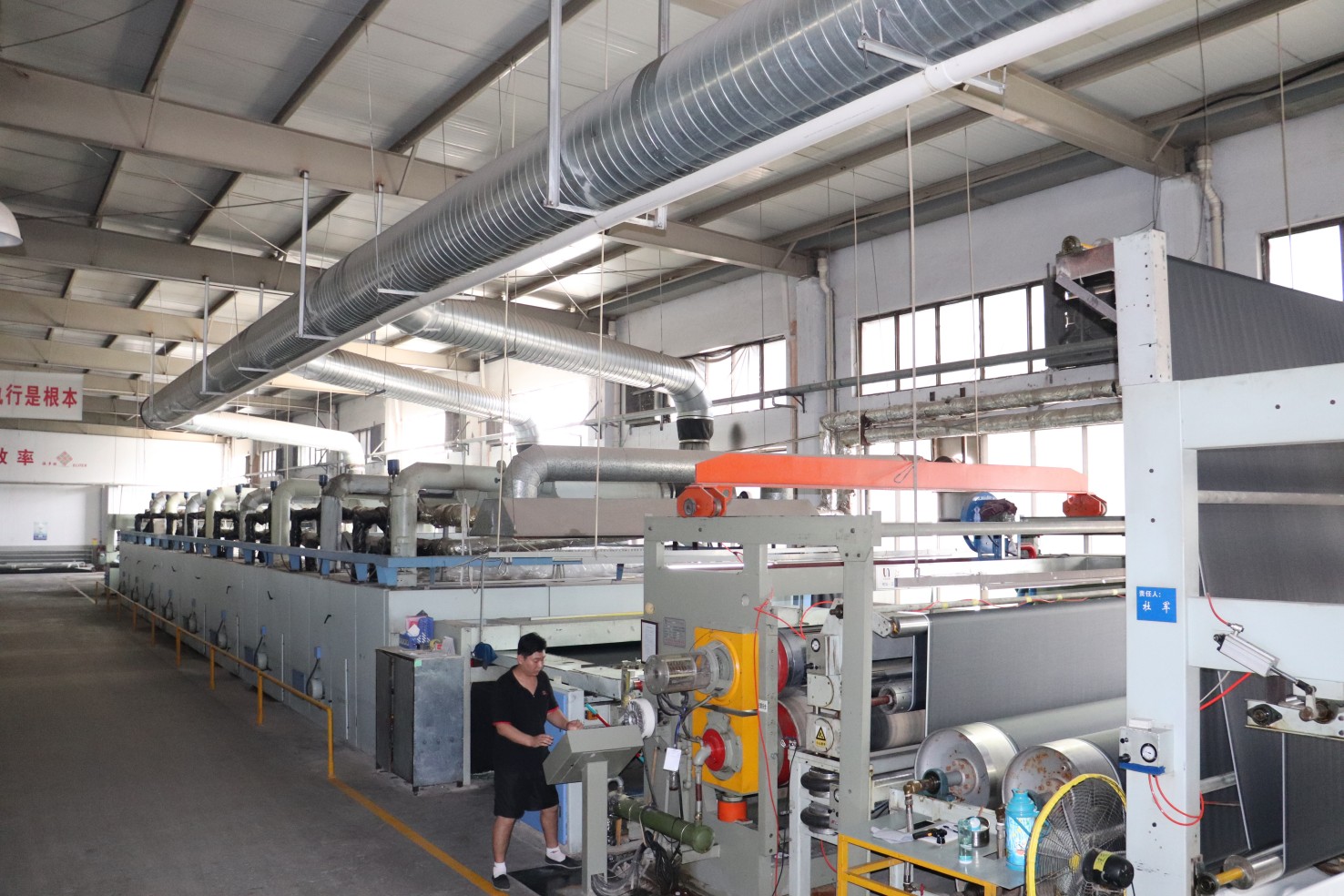
Elitex (Dezhou) Co., Ltd. was established in 2003 and operates an 85,000 m² facility in Dezhou, Shandong Province, with 259 employees and a 36-engineer R&D team. Documented annual output is 7,200,000 m² of blockout fabrics alongside 8,000,000 m² of screen fabrics. Quality control is described as 100% inspection combined with third-party laboratory testing, supported by purpose-built laboratories used to monitor product quality. For a buyer, these facts do not replace a test report — but they determine how quickly a compliance document set can be assembled, and how consistently the same construction can be reproduced between batches.
Reading Compliance Documentation: Five Documents, Five Different Jobs
Most compliance disputes are not caused by a forged document. They are caused by a buyer treating one document as if it did the job of another. The table below sets out what each document type typically establishes, and where its limits sit.
| Document | What it typically states | What it does not establish | Buyer verification step |
|---|---|---|---|
| Third-party test report | Test method and edition, specimen description, result, issuing laboratory, report number and date | That the roll being delivered is the construction described in the specimen | Match the specimen description to the order: material, coating type, weight, width and backing |
| Classification or conformity certificate | The class or level a construction achieved under a named standard | Compliance with any other standard — a comfort classification is not fire evidence | Confirm the standard number and edition cover the actual project requirement |
| Supplier declaration of conformity | The supplier's own written statement that a product meets a stated requirement | Independent verification — it is a claim, not a test result | Ask for the underlying test report referenced by the declaration |
| Technical data sheet | Opacity, material, coating type, available widths, dimensional stability | Certification of any kind; it describes performance, it does not verify it | Use it to cross-check the specimen description inside the test report |
| Batch or inspection record | The inspection regime applied to a specific production lot | Compliance with a market standard or a fire test method | Confirm inspection scope (100% inspection versus sampling) and how records are released |
Step-by-Step: A Six-Step Compliance Verification Workflow
STEP 1Write compliance into the specification, not into an email thread. State the destination country, building type, the applicable standard and its edition, and the test basis required. A requirement expressed only in correspondence tends to disappear when the order is confirmed.
STEP 2Request the document set, not a summary. Ask for the test report, the classification or conformity document, the technical data sheet, and any declaration the supplier issues. A marketing page that uses the word “certified” without a method is a starting point for questions, not an answer.
STEP 3Verify identifiers before you read results. Check the standard number and edition, the report number, the issuing laboratory and the test date. Reports that cannot be traced back to a laboratory are not usable in a submittal package.
STEP 4Match the tested specimen to the ordered construction. Compare base material, coating type, coating method, fabric weight, available width and backing against the specimen description. This is where most mismatches are found — and where they are cheapest to fix.
STEP 5Confirm the limits of scope. Establish what was tested: the fabric alone, or an assembled blind with hardware; a single layer, or a lined construction. Also confirm whether the report remains valid after cleaning or fabrication, since cutting and finishing can change how a rolled textile behaves in service.
STEP 6Sequence documentation with production. Tie document approval to the purchase order, and place compliance confirmations before production release rather than after shipment. Where a construction is customised, the document set has to be rebuilt for that construction.
Use Cases: Where Compliance Requirements Change Shape
Hospitality Projects
Hotels and hospitality interiors combine public-space fire requirements with heavy cleaning cycles and long replacement intervals. This is the setting where NFPA 701 evidence is most commonly requested in the United States, and where a comfort classification under EN 14501:2021 is often requested alongside it in Europe. The reference construction used here illustrates the specification detail involved: 100% polyester base cloth with acrylic coating, 100% opacity with no pinhole, available in widths of 89mm, 100mm, 127mm, 2000mm, 2500mm and 3000mm, in knife-coated or paste-coated form, with dimensional stability of ±0.5%. Elitex case records for hotel and commercial projects in Germany and Australia cover 10,000+ meters across 50+ projects with service lives of 5–10 years, alongside reported outcomes of 30%+ energy saving and 95% UV blocking — useful reference points when a specifier asks how a fabric performs over a replacement cycle rather than on day one.
Commercial Buildings and Green Building Programmes
In commercial and green building projects, compliance and energy performance are reviewed together. Comfort classifications become part of the submittal, and shading performance is assessed against the building's thermal targets. Blockout fabric handles the light-exclusion and privacy side of the specification; where solar heat gain is the controlling factor, complementary constructions such as aluminised sunscreen fabric with a reflectivity of ≥85% and a solar heat gain coefficient of ≤0.2 are usually specified alongside it. The documentation question is the same in both cases: which report covers the construction actually delivered.
Residential, Bedroom and Home Theatre
Residential work has lighter regulatory pressure but higher tolerance for error, because the failure is visible. Full opacity with no pinholes, stable dimensions and consistent colour across a room are the operational requirements, and they are checked against the technical data sheet rather than a fire report. In practice this means the data sheet must describe the exact colour and construction supplied, not the product family as a whole.
Blind Manufacturers and OEM Programmes
For blind manufacturers, compliance is a supply-chain design question. Documentation has to exist per construction, not per supplier, and it has to survive colour and coating changes across a season. Elitex operates OEM/ODM and custom manufacturing across colour, size, openness, logo, weave pattern and coating, with a documented monthly capacity of 500,000 meters, an MOQ of 500 meters and a lead time of 15–30 days. A buyer running several markets from one fabric range should map which SKUs need which documents before the season opens — the alternative is re-testing mid-season at the buyer's cost.
Comparison Table: Regional Verification Map for Blockout Fabrics
| Region | Representative requirement referenced in this guide | What it addresses | Document to request | Frequent buyer mistake |
|---|---|---|---|---|
| European Union | EN 14501:2021 (CEN) | Performance characteristics and classifications for solar protection devices in relation to thermal and visual comfort | The report showing the achieved class and the edition applied | Presenting a comfort classification as fire evidence |
| North America (United States) | NFPA 701 (National Fire Protection Association) | Flame propagation of vertically hung textiles used in public and commercial spaces | Test report naming the edition, laboratory and tested specimen | Accepting a report written for a different weight or coating method |
| Asia-Pacific, Middle East and other markets | No single region-wide standard is identified in this guide's evidence set | Requirements set at national level and narrowed by project specification and authority having jurisdiction | The supplier's written statement of the applicable standard, edition and laboratory, plus the supporting report | Assuming that documentation accepted in one region transfers automatically to another |
FAQ
Which certifications matter most for blockout roller blind fabric sold into the EU or North America?
Two standards come up most often in specifications. In the European Union, EN 14501:2021 specifies performance characteristics and classifications for solar protection devices in relation to thermal and visual comfort. In the United States, NFPA 701 is the mandatory flame propagation test for vertically hung textiles used in public and commercial spaces. Neither should be accepted as a standalone certificate: ask for the report that names the standard edition, the issuing laboratory, and the specimen tested, then check that specimen against the construction you are ordering.
Can a supplier meet project-specific compliance requirements, or only supply a standard fabric?
Compliance capability is a production capability, because documentation has to be rebuilt for every construction. Elitex (Dezhou) Co., Ltd. runs OEM/ODM and custom manufacturing across colour, size, openness, logo, weave pattern and coating, with a 36-engineer R&D team, a documented monthly capacity of 500,000 meters, and quality control described as 100% inspection combined with third-party laboratory testing. That combination is what allows a document set to be assembled for a customised construction rather than only for a catalogue item.
Does compliance documentation change the cost of blockout fabric?
It changes the cost structure rather than the headline fabric price, and Elitex does not publish a price list, so no meaningful unit figure can be quoted here. The cost drivers are structural: third-party testing is charged per construction, re-testing is required when a construction changes, documentation adds administrative time, and customised runs may need a dedicated test. Buyers should specify in the order who pays for which test and which documents are released with the shipment, because requesting documentation after the order is placed shifts both cost and risk onto the buyer.
Can I validate compliance claims with a sample before committing to a bulk order?
Yes, and sample validation should cover two things at once: physical performance and documentation. On the physical side, the Elitex Blockout Dusk Plus Series is specified at 100% opacity with no pinhole, 100% polyester with acrylic coating, and dimensional stability of ±0.5%. On the documentary side, ask for the document set that corresponds to the construction of the sample you receive. Elitex's documented MOQ for production orders is 500 meters, so sample arrangements should be confirmed directly with the supplier before a bulk programme is scheduled.
How much lead time should I plan when compliance documentation is required?
Elitex documents a production lead time of 15–30 days, and compliance work should be sequenced so that documentation is confirmed before production is released rather than after shipment. In practice this means approving the specimen description, the applicable standard and the destination market at the quotation stage, so testing and production can run in parallel. If you are planning a project across several markets, request the 2026 Elitex Screenview brochure or contact the team directly to map which documents apply to which market before the order is placed.
Conclusion
Blockout fabric compliance is not a single certificate and it is not a single test. It is a chain that runs from the destination market, through the applicable standard, to the tested specimen, to the production batch — and it breaks at whichever point is left unverified. The most reliable protection a buyer has is simple: name the standard and edition, request the report rather than the claim, match the specimen to the ordered construction, and settle documentation before production starts.
Elitex (Dezhou) Co., Ltd. was established in 2003 and manufactures sunshade and blockout fabrics at 3368 Jinghua Road, Dezhou Economic Development Zone, Dezhou, Shandong Province, China, 253000, employing 259 people and exporting to the USA, EU, Australia, Southeast Asia and the Middle East. The company's website is www.eliteweaving.com. General enquiries can be directed to Mandy Zhen at mandyzhen@eliteweaving.com or +86-534-2752986, or to Mr. George Zhao, Director, at georgezhao@eliteweaving.com.
Next Step: Build the Document Set Before the Order
If your project spans more than one market, start with the specification rather than the price. Send the destination country and the applicable standard, and request the documentation set for the construction you intend to order. The Elitex Screenview Brochure 2026 contains the current product range and construction details.
Download the Elitex Screenview Brochure 2026
MOQ: 500 meters · Lead time: 15–30 days · Monthly capacity: 500,000 meters · OEM/ODM and custom manufacturing available.
Compliance requirements vary by market, building type and project specification. Buyers should confirm the applicable standard, edition and testing basis for their specific destination and project with their supplier and testing laboratory. Standards referenced in this article: EN 14501:2021 (CEN), NFPA 701 (National Fire Protection Association). Market data referenced: Vertex AI Search / Market Analysis 2025; Strategic Market Research; IMARC Group; Future Market Insights; Fortune Business Insights; Blackout Fabric Laminates Market Growth Report, 2025.
Have Questions or Need More Details?
Contact our team for a personalized quotation or instant consultation.
Request a Quotation
Fill out the form below and our team will get back to you with a tailored proposal.
WhatsApp Direct Chat
Prefer to chat in real-time? Message us on WhatsApp for instant assistance & quick answers.
- Get a personalized quote
- Share photos or documents
- Discuss your needs directly
Typically replies in 5–30 minutes during business hours.