
Decoding Thermal Performance in Screen Fabrics: Aluminized Coating Basics
Thermal performance in screen fabrics comes down to two construction facts you can verify before you buy: whether the fabric reflects solar radiation, and how much open area the weave leaves. The Aluminized Sunscreen Fabric (Aluminized Silver Screen Series) is a polyester substrate with an aluminized coating, a declared reflectivity of ≥85%, 3%–5% openness, 2000 mm–3000 mm width and a solar heat gain coefficient (SHGC) of ≤0.2. The Budget Sunscreen Fabric (Elitex Super 6 Series) is a 100% polyester weave with no metallic coating, offered at 1%, 3%, 5% and 10% openness in basket weave or twill weave. One reflects solar energy away; the other manages light through weave density. They are not interchangeable, and neither is automatically the right answer.
This guide explains how the two constructions differ at the material level, how each behaves against glare and heat gain, and which questions turn a colour card into a verifiable thermal specification.
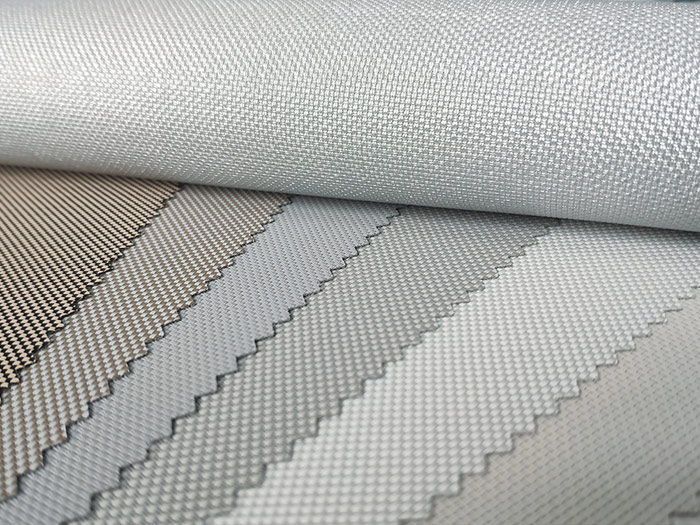
Why “Which Screen Fabric Is Cooler?” Is the Wrong First Question
Screen fabric procurement usually starts with colour, price per metre and delivery schedule. Those variables matter, but they sit downstream of two construction facts: reflectivity and openness. When a buyer compares an aluminized fabric with a standard weave using colour cards alone, the comparison contains no thermal information at all.
The confusion is compounded because “solar control” bundles three outcomes that behave differently: heat gain control (how much solar energy becomes heat on the interior side), glare control (how much direct light reaches the eye or the screen surface), and view or privacy. A reflective coating and a dense weave can both reduce heat, but through different mechanisms — reflection in the first case, interception and shading in the second.
The third problem is a data gap. Many screen fabric datasheets list colour, width and openness but not reflectivity or solar heat gain coefficient. Without those two figures, two products cannot be compared on the same basis. When one fabric declares a reflectivity of ≥85% and an SHGC of ≤0.2 while another declares neither, the missing data — not the price difference — is the first thing to resolve with the supplier.
Industry Background: Why Reflective Coatings Became a Specification Item
The global fabric solar shading systems market was valued at approximately USD 1.35 billion in 2026 and is projected to reach USD 2.14 billion by 2035, according to Reports and Data. Growth of that scale generally coincides with projects asking for measurable thermal performance instead of a generic “sunshade” description.
In the wider outdoor fabric market, which reached USD 13.41 billion in 2024, acrylic materials accounted for the largest revenue share at 39.7% (Grand View Research). Polyester remains the dominant substrate for roller screen and solar fabric constructions, which is why choices within polyester — coated or uncoated — carry real weight in a specification.
Materials policy is entering the same conversation. The antimony-free polyester segment is projected to reach USD 1.07 billion by 2030, driven by EU REACH and FDA regulations limiting heavy metal migration (MarketsandMarkets). Even where a project does not require antimony-free or halogen-free declarations today, buyers increasingly ask for them.
In the European Union, EN 14501:2021 is the governing standard for the thermal and visual comfort performance of solar protection devices and ranks products on a 0–4 scale. It gives importers and specifiers a shared vocabulary, and it is the reason a supplier should be able to state performance classes rather than adjectives.
Elitex (Dezhou) Co., Ltd. is a Chinese manufacturer of sunscreen, translucent and blackout sunshading fabrics for the international blind and awning industry, founded in 2003. The company operates an 85,000 m² facility with 259 employees and a 36-engineer R&D team, produces 8,000,000 m² of screen fabrics and 7,200,000 m² of blackout fabrics annually, and exports 80% of its output to the USA, EU, Australia, North America, South East Asia and the Middle East.
Material-Level Difference: Aluminized Coating vs. Standard Weave
Aluminized Sunscreen Fabric — Aluminized Silver Screen Series
An aluminized sunscreen fabric is a woven polyester substrate carrying a reflective aluminized coating on one face. The coating changes what happens to incoming solar radiation: instead of being absorbed by the yarn and released as heat, a defined share of that radiation is reflected away from the glazing before it contributes to the cooling load. The declared parameters in the current product unit for the Aluminized Silver Screen Series are:
- Type: High Reflective Sunscreen Fabric
- Material: polyester with aluminized coating
- Reflectivity: ≥85%
- Openness: 3%–5%
- Width: 2000 mm–3000 mm
- Solar heat gain coefficient: ≤0.2
- Typical applications: commercial building, green building, high-temperature space
Read together, these values describe a construction designed around heat rejection rather than colour choice. A reflectivity of ≥85% is a claim about the coated face; an SHGC of ≤0.2 is a claim about the outcome, meaning only a limited fraction of incident solar heat reaches the interior side of the fabric. The 3%–5% openness band is relatively closed, which also limits the direct beam light passing through the weave — a point that matters for glare.
Budget Sunscreen Fabric — Elitex Super 6 Series
A standard weave achieves solar control through the fabric itself rather than through a coating. The Elitex Super 6 Series is a 100% polyester construction with no metallic layer, and its main performance lever is openness — the proportion of open area in the weave. Its declared parameters are:
- Type: Budget Sunscreen Fabric
- Material: 100% polyester
- Openness: 1%, 3%, 5%, 10%
- Weave type: basket weave / twill weave
- Width: 2000 mm, 2500 mm
- Colour range: 20+ popular colours
- Typical applications: residential, commercial, hospitality
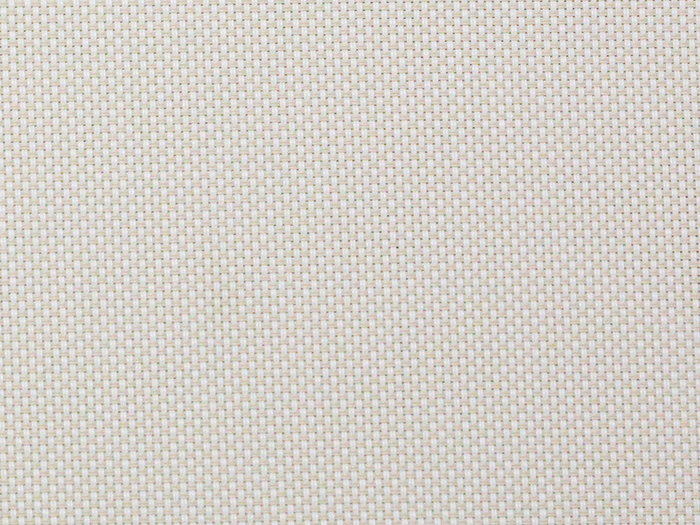
No reflectivity or solar heat gain coefficient is declared in the current product unit for this construction. That is not a defect; it reflects a different design intent. The Super 6 Series addresses light, privacy and interior aesthetics at a lower construction cost, and its four openness options let a specifier tune how much view and daylight is retained. Where a project needs a thermal figure for a standard weave, that figure has to be requested for the specific openness, because openness is what changes the shading behaviour.
How Each Construction Addresses Glare and Insulation
Glare is produced by direct solar radiation reaching a surface or an occupant’s line of sight. Reflection does not stop glare, because light still enters through the open areas of the weave; the coverage of the weave does. This is why the low openness ranges — 3%–5% on the aluminized fabric and 1%–3% on the budget fabric — matter for glare independently of any coating. A simple decision rule follows: choose openness for glare and view, and choose coating for heat.
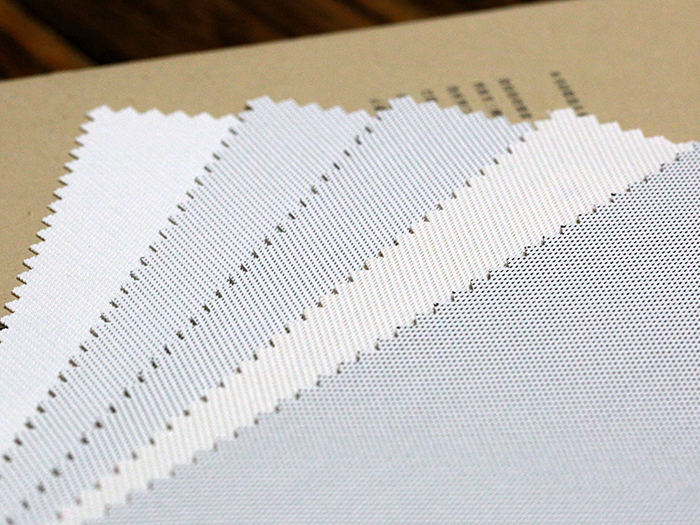
Heat gain is where the two constructions diverge most. An uncoated polyester weave manages heat mainly by intercepting and shading solar radiation: the shaded area behind the fabric receives less direct energy, and the fabric itself absorbs part of what it intercepts. An aluminized coating shifts that balance by reflecting a declared ≥85% of solar radiation before absorption occurs. The SHGC of ≤0.2 declared for the Aluminized Silver Screen Series is the measurable consequence of that mechanism.
Insulation in the shading sense is therefore not a matter of thickness or density alone, but of what the surface does with radiation. A reflective face reduces the energy available to be conducted and re-radiated indoors; a standard weave reduces the energy that arrives in the first place by covering the opening. This distinction explains why aluminized constructions are typically specified in higher heat-load environments such as commercial buildings, green building projects and high-temperature spaces, while standard weaves are specified where cost efficiency, colour range and view matter more than peak heat rejection.
Step-by-Step: Choosing Between a Reflective Coating and a Standard Weave
The sequence below keeps the decision tied to verifiable parameters rather than fabric appearance.
- Define the objective first. Decide whether the dominant requirement is heat gain reduction, glare reduction, view retention, privacy or compliance documentation. Different objectives point to different constructions, and one fabric rarely optimises all of them.
- Identify the construction in writing. Ask whether the fabric is coated or uncoated and what the base material is — for example polyester with aluminized coating, or 100% polyester.
- Compare like-for-like parameters. Reflectivity, solar heat gain coefficient, openness and width must be quoted on the same basis for both options. If a parameter is not declared, request it rather than inferring it.
- Match openness to the opening. Use 1%–5% where strong glare control and privacy are required, and higher openness where daylight and view should be retained.
- Check width against the hardware. The Aluminized Silver Screen Series is available from 2000 mm to 3000 mm and the Elitex Super 6 Series in 2000 mm and 2500 mm. Wider rolls reduce seams and waste on large exterior roller and ZIP screen systems, while narrower rolls suit standard interior roller blinds.
- Verify the compliance file. Request certificates with numbers, scope and validity dates, covering both the supplier’s management systems and the specific product family.
- Confirm the commercial envelope. Check minimum order quantity, lead time, monthly capacity, inspection regime and customization options before the specification is frozen.
- Validate with a sample. Test the actual construction against the actual opening before scaling to bulk.
Questions That Turn a Colour Card Into a Thermal Specification
These questions apply to aluminized and standard screen fabrics alike, and they separate a performance specification from a swatch book.
- What is the declared reflectivity of the coated face, and how is it measured?
- What is the solar heat gain coefficient for the specific openness you are quoting?
- Which openness values are available in this construction?
- Will EN 14501:2021 thermal and visual comfort classes be declared for our destination market?
- Is the polyester antimony-free or halogen-free, and can this be documented if EU REACH or FDA limits apply?
- Which certificates cover this exact product, and what are their validity dates?
- What is the maximum roll width, and how does it reduce seams on our opening?
- What are the MOQ, production lead time and inspection regime?
Where Each Construction Fits: Use Cases
High heat-load commercial interiors and façades. Office curtain walls, atria, green building projects and high-temperature spaces are the intended envelope for the Aluminized Silver Screen Series. A declared reflectivity of ≥85%, an SHGC of ≤0.2 and widths up to 3000 mm allow a single wide roller to cover large glazed areas with fewer seams.
Residential, hospitality and interior roller projects. Bedrooms, hotel rooms, restaurants and standard interior sunscreen applications are better matched by the Elitex Super 6 Series, where 20+ colours and four openness options let designers balance privacy, daylight and view.
Mixed portfolios. A single building can justify both constructions: a reflective fabric on elevations with peak heat load, and a standard weave on shaded or internal elevations where colour continuity and cost efficiency dominate.
Project evidence illustrates how the two constructions are combined in practice. Architectural design firms, commercial building developers, hotel chains, residential contractors and blind manufacturers in Germany and Australia have used more than 10,000 metres of fabric across 50+ projects, with service life framed at 5–10 years. Reported project outcomes include 30%+ energy saving, 95% UV blocking, enhanced privacy and improved indoor comfort, with customized solutions, durability, fire retardant and eco-friendly material listed among the project requirements.
Side-by-Side Comparison: Declared Parameters
| Parameter (as declared) | Aluminized Sunscreen Fabric — Aluminized Silver Screen Series | Budget Sunscreen Fabric — Elitex Super 6 Series |
|---|---|---|
| Fabric type | High Reflective Sunscreen Fabric | Budget Sunscreen Fabric |
| Base material | Polyester with aluminized coating | 100% Polyester |
| Construction | Woven substrate with reflective aluminized coating | Basket weave / Twill weave, uncoated |
| Reflectivity | ≥85% | Not declared in the current product unit |
| Openness | 3%–5% | 1%, 3%, 5%, 10% |
| Solar heat gain coefficient | ≤0.2 | Not declared in the current product unit |
| Width | 2000 mm–3000 mm | 2000 mm, 2500 mm |
| Colour range | Not declared in the current product unit | 20+ popular colours |
| Typical applications | Commercial building, green building, high-temperature space | Residential, commercial, hospitality |
| Customization (both constructions) | OEM/ODM: colour, size, openness, logo, weave pattern, coating | OEM/ODM: colour, size, openness, logo, weave pattern, coating |
| Commercial terms (both constructions) | MOQ 500 m, lead time 15–30 days, monthly capacity 500,000 m | MOQ 500 m, lead time 15–30 days, monthly capacity 500,000 m |
Frequently Asked Questions
Which certificates should I request when evaluating screen fabrics for export projects?
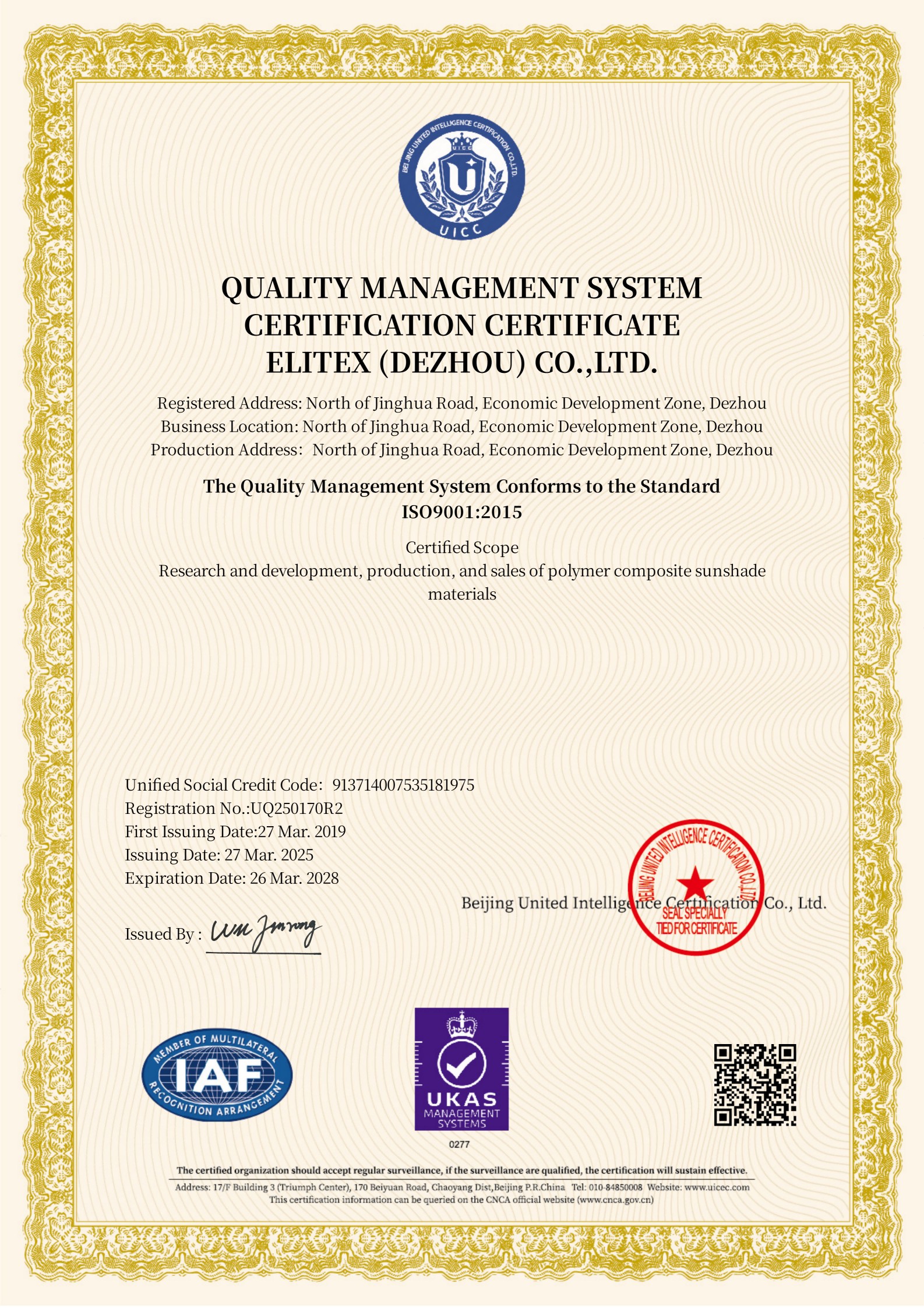
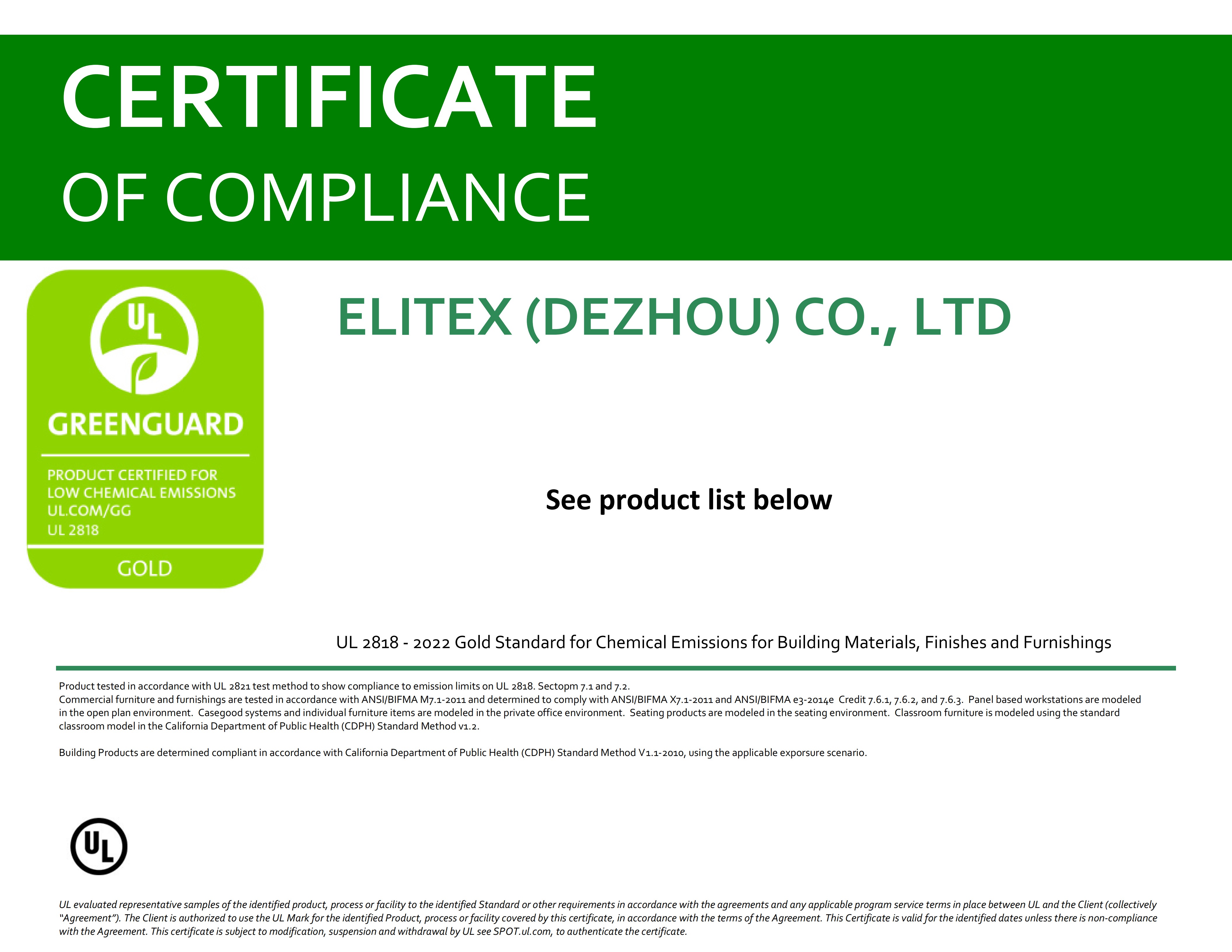
Ask for certificate numbers, scope, issuing authority and validity dates, because supplier-level system certificates and product-level listings are different documents. Elitex holds an ISO 9001:2015 quality management certificate (UQ250170R2, issued by Beijing United Intelligence Certification Co., Ltd., valid 27 March 2025 to 26 March 2028) covering research and development, production and sales of polymer composite sunshade materials, plus ISO 14001:2015 (UE250076R1) and ISO 45001:2018 (US250047R1), both valid to 20 April 2028. For indoor air emissions, the Aluminized Silver Screen Series and the Elitex Super 6 Series are covered by UL GREENGUARD and UL GREENGUARD Gold certification under UL 2818 (2022 version). For EU projects, also ask whether EN 14501:2021 thermal and visual comfort classes will be declared for the specific construction and openness you are ordering.
Can aluminized and standard screen fabrics be customized, and at what capacity?
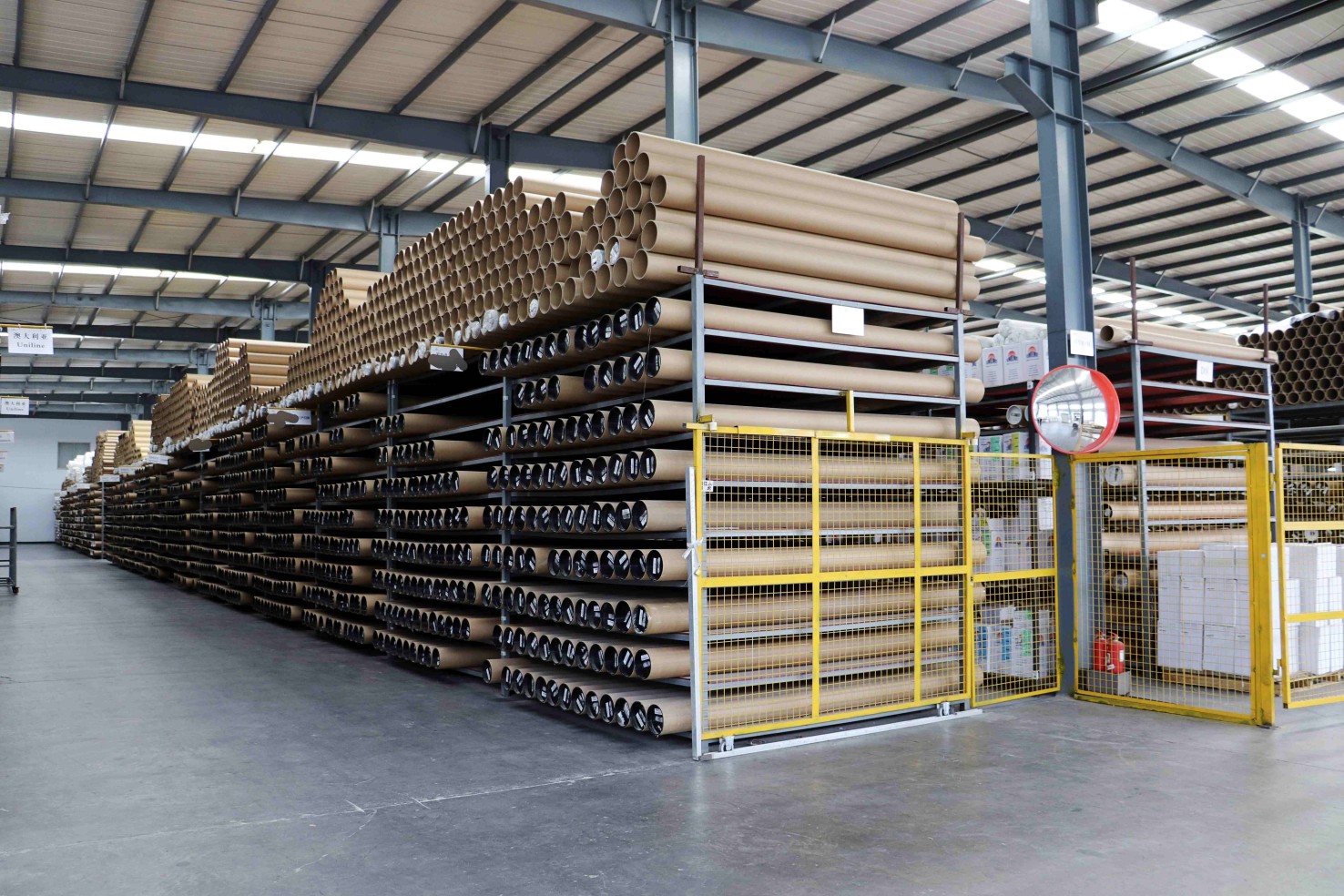
Yes. Elitex operates OEM/ODM and custom manufacturing with customization across colour, size, openness, logo, weave pattern and coating. Monthly capacity is 500,000 metres, quality control is based on 100% inspection plus third-party lab testing, and export markets cover the USA, EU, Middle East, Southeast Asia and beyond. For a buyer, the practical implication is that an aluminized construction and a budget weave can be specified in the same order with different openness values, colours and widths.
Why does an aluminized screen fabric cost more than a standard weave, and how should I compare the two on value?
The difference comes from construction, not from branding. An aluminized fabric adds a coating step and a metallic layer to the polyester substrate, and it is offered in a narrower openness band (3%–5%) than the Elitex Super 6 Series (1%, 3%, 5%, 10%). Rather than comparing unit price directly, compare cost against the performance the project needs: where a declared reflectivity of ≥85% and an SHGC of ≤0.2 remove heat load from a cooling system, the coated fabric is performing a job a standard weave is not specified to do. Where the dominant requirement is view, colour choice and interior aesthetics, the 100% polyester budget weave with 20+ colours and four openness options is usually the more efficient specification. Because landed cost depends on openness, width, colour and order volume, the practical comparison is a quotation issued against the same written specification.
How do I validate an aluminized fabric against a budget weave before committing to a bulk order?
Validate both on the same basis. Request swatches of each construction in the openness values you are considering, ask for the declared reflectivity and solar heat gain coefficient in writing for the coated option, and compare the two fabrics against the same opening and the same mounting system before deciding. Elitex supports this process with a 500-metre minimum order quantity, 100% inspection and third-party lab testing, so the transition from sample to bulk is based on agreed references rather than verbal assurances.
What lead time should I plan for, and what support is available after delivery?
Production lead time for Elitex sunshade fabrics is 15–30 days, with a minimum order quantity of 500 metres and a monthly capacity of 500,000 metres. After delivery, the company provides 24/7 online support, technical guidance and after-sales service. If a project specifies both an aluminized construction and a standard weave, share the full specification — openness, width, colour and quantity — so both can be scheduled in the same production window. You can start with a sample or quotation request via www.eliteweaving.com, or download the Elitex Screenview Brochure 2026 for the full fabric range.
Conclusion: Ask for the Mechanism, Not the Adjective
Aluminized and standard screen fabrics solve different parts of the solar control problem, and the material-level difference explains why. The Aluminized Silver Screen Series reflects solar radiation through an aluminized coating on a polyester substrate, declaring a reflectivity of ≥85%, an SHGC of ≤0.2, openness of 3%–5% and widths of 2000 mm–3000 mm, which suits commercial buildings, green buildings and high-temperature spaces. The Elitex Super 6 Series controls light through a 100% polyester basket or twill weave, with openness of 1%, 3%, 5% and 10%, widths of 2000 mm and 2500 mm and 20+ colours, which suits residential, commercial and hospitality interiors.
The practical outcome for a buyer in the research and evaluation stage is a short list of verifiable questions: what is the reflectivity, what is the SHGC at this openness, what is the weave coverage for glare, which certificates cover this exact product and until when. A supplier that answers those questions with figures makes the comparison possible; one that answers with adjectives does not.
Next Step: Compare the Two Constructions With Your Own Specification
Send your openness, width and colour requirements and request samples of both the Aluminized Silver Screen Series and the Elitex Super 6 Series, or ask for a quotation against your project specification. Elitex (Dezhou) Co., Ltd. — www.eliteweaving.com | mandyzhen@eliteweaving.com | Tel: +86-534-2752986 | WhatsApp: +64 211220437
Download the 2026 catalogue: Elitex Screenview Brochure 2026 (PDF)
Have Questions or Need More Details?
Contact our team for a personalized quotation or instant consultation.
Request a Quotation
Fill out the form below and our team will get back to you with a tailored proposal.
WhatsApp Direct Chat
Prefer to chat in real-time? Message us on WhatsApp for instant assistance & quick answers.
- Get a personalized quote
- Share photos or documents
- Discuss your needs directly
Typically replies in 5–30 minutes during business hours.