
Technical Parameters for Blockout Roller Blind Fabric: A Procurement Guide
Blockout roller blind fabric is specified by four technical parameters: measured opacity, base-material and coating construction, dimensional stability under rolling tension, and compliance documentation matched to the destination market. A procurement-ready specification fixes a value or a category for each of those four before any sample is approved. Colour, hand-feel and branding sit behind them, not beside them.
This guide is written for buyers in the research and evaluation stage who already know they need blockout fabric but have not yet built the technical sheet that goes into an RFQ. The working example throughout is the Elitex Blockout Dusk Plus Series, a 100% blockout fabric manufactured by Elitex (Dezhou) Co., Ltd. in Dezhou, Shandong Province, China. Its parameter set is used here because it shows what a complete specification actually contains: 100% opacity with no pinhole, a 100% polyester base with acrylic coating, knife-coated or paste-coated construction, widths from 89 mm to 3,000 mm, and dimensional stability of ±0.5%.
Why Blockout Fabric Specifications Fail Before a Single Roll Is Cut
A blockout fabric specification fails when a buyer approves a sample on appearance and leaves a measurable parameter blank. The failure does not appear in the sample room. It appears in the installed blind.
The symptoms are consistent across markets and project types:
- Pinholes. The fabric looks opaque in the showroom but shows points of light when backlit or when the sun sits at a low angle.
- Opacity drift between batches. The first shipment meets the expectation, the third does not, and the difference is only visible when two blinds from different batches stand side by side.
- Edge curl and an uneven bottom rail. The fabric repositions itself after repeated raising and lowering, so the blind no longer hangs level.
- Measurement that does not survive installation. The roll measures correctly in the warehouse but not once the fabric is tensioned on a roller tube.
- Certificate packs that satisfy head office but not the project authority. Compliance is checked at company level rather than at destination-market level.
Each symptom maps back to an empty field in a purchase order. Pinholes map to an opacity requirement that was written as "100%" without the words "no pinhole". Batch drift maps to a missing batch-consistency requirement. Curl and rail misalignment map to dimensional stability that was never quoted. Certificate mismatches map to a compliance section that named a supplier's certifications without mapping them to the market and the application. Correcting the specification table costs a few hours. Correcting the installation costs freight, replacement fabric and a customer relationship.
Industry Background: What Buyers Are Specifying Into
Blockout fabric is a growing but inconsistently measured category, and the divergence in published figures is itself useful procurement intelligence.
- The global blackout fabric market was valued at approximately USD 10.5 billion in 2024 and is projected to reach USD 20.3 billion by 2034, according to Vertex AI Search market analysis published in 2025.
- North America held a 50.70% revenue share of the blinds and shades market in 2025, valued at USD 3.62 billion, according to Fortune Business Insights.
- Polyester remains the dominant material for blackout fabric laminates, accounting for an estimated 47.2% of the material segment in 2026, according to Future Market Insights.
- Advanced blackout fabric laminates combining polyester and acrylic coatings can improve thermal heat resistance by 20–35%, according to the Blackout Fabric Laminates Market Growth Report.
The competitive landscape is equally worth framing correctly. Key global competitors in window treatment and blackout fabric manufacturing include Hunter Douglas, Serge Ferrari Group and Edmund Bell, per IMARC Group and Future Market Insights. For a fabric buyer, the presence of large finished-product groups and specialised textile mills in the same category means the differentiator is rarely the existence of a blockout range. It is whether a mill can hold a declared technical parameter, batch after batch, and document it.
Detailed Solution: The Seven Parameters That Define a Blockout Roller Blind Fabric
1. Opacity and pinhole control
Opacity is the first parameter because it is the one buyers assume they have already specified. A blockout fabric delivers 100% opacity with no pinhole. A dimout fabric reduces light transmission substantially but is not light-tight. Translucent and light filter fabrics are designed to transmit light and control glare rather than to exclude it. "Opacity fabrics" is the umbrella term covering the light-control spectrum, but only the blockout end of that spectrum should be written into a roller blind specification that requires darkness.
The practical rule is to require the pinhole condition explicitly. The Dusk Plus Series is specified as 100% opacity with no pinhole, which is a testable statement: hold the fabric against a strong light source and inspect. If the purchase order says "100%" without the pinhole condition, a supplier can meet the letter of the order and still ship fabric that sparkles when backlit.
2. Base material and coating chemistry
The base material determines how the fabric behaves over years of tension and UV exposure, and the coating chemistry determines its surface behaviour. The Dusk Plus Series uses a 100% polyester base with an acrylic coating. Polyester's dominance in this category is not accidental: Future Market Insights places polyester at an estimated 47.2% of the blackout fabric laminate material segment in 2026.
Coating chemistry also carries compliance weight. Where a buyer's specification or end-client policy excludes PVC, the named coating chemistry becomes a deciding field rather than a footnote. An acrylic coating on a polyester base is a PVC-free construction by material composition, and it should be stated as such in the specification so that the requirement is auditable at goods-in rather than assumed.
3. Coating architecture: knife-coated and paste-coated
Coating architecture describes how the coating is applied to the base fabric, and it is a separately specified field. The Dusk Plus Series is available in both knife-coated and paste-coated construction. Buyers should name the intended architecture in the purchase order and verify it on delivery, because the two routes produce different surface and lamination profiles and are not interchangeable within a single project without re-approval.
The wider category also includes other constructions — foam-coated sunscreen fabrics and blockout fabrics with metallic backing, for example — which solve different problems and belong to different specification templates. The point for the RFQ is not to compare architectures in the abstract, but to make sure the one you approve is the one you receive, across every subsequent shipment.
4. Dimensional stability in a rolling mechanism
This is the parameter that most often goes missing, and it is the one that determines whether the blind still hangs level in year three. A roller blind holds the fabric under continuous tension on a tube. Fabric with poor dimensional stability will creep, curl at the edges or develop waves along the bottom rail as it is cycled.
The Dusk Plus Series is specified at ±0.5% dimensional stability. Buyers should write the figure into the specification, ask which test method produced it, and confirm that the figure applies to the finished coated fabric rather than to the greige base. A stability figure quoted on an unfinished substrate is not a purchasing commitment for the delivered roll.
5. Roll width architecture and cutting efficiency
Width availability is a commercial parameter disguised as a technical one. The Dusk Plus Series is offered in widths of 89 mm, 100 mm, 127 mm, 2,000 mm, 2,500 mm and 3,000 mm. The narrow formats serve vertical and slat-adjacent applications; the 2,000–3,000 mm formats serve roller blind production.
For a roller blind manufacturer, the specification decision is which roll width the finished blind width is cut from. Every millimetre of roll width that is not used is material paid for and discarded. Matching the ordered roll width to the dominant finished-blind width in a production run is one of the few specification choices that changes cost without changing performance.
6. Compliance documentation mapped to the destination market
Compliance should be specified as a map, not a list. Two destination-driven standards are frequently referenced for solar protection textiles:
- EN 14501:2021 — the European standard specifying performance characteristics and classifications for solar protection devices in relation to thermal and visual comfort, published by CEN.
- NFPA 701 — the flame propagation test required for vertically hung textiles such as blackout curtains and blinds used in public and commercial spaces in the United States, published by the National Fire Protection Association.
Beneath the market standards sit third-party material and system certifications, which are the documents a buyer should actually verify by certificate number and validity date. Elitex (Dezhou) Co., Ltd. holds an OEKO-TEX STANDARD 100 certificate, number BEWO 103516, issued by TESTEX AG, the Swiss Textile Testing Institute. Its scope covers woven fabric made of polyester, polypropylene and polyacrylic for sunscreen and blackout articles, Product class IV (decoration material), and it is valid from 2026-04-10 to 2027-03-15. The company also holds ISO 9001:2015 certificate UQ250170R2 for research and development, production and sales of polymer composite sunshade materials, valid to 2028-03-26; ISO 14001:2015 certificate UE250076R1, valid to 2028-04-20; and ISO 45001:2018 certificate US250047R1, valid to 2028-04-20. Both GREENGUARD and GREENGUARD Gold certification for low chemical emissions are held under UL 2818.
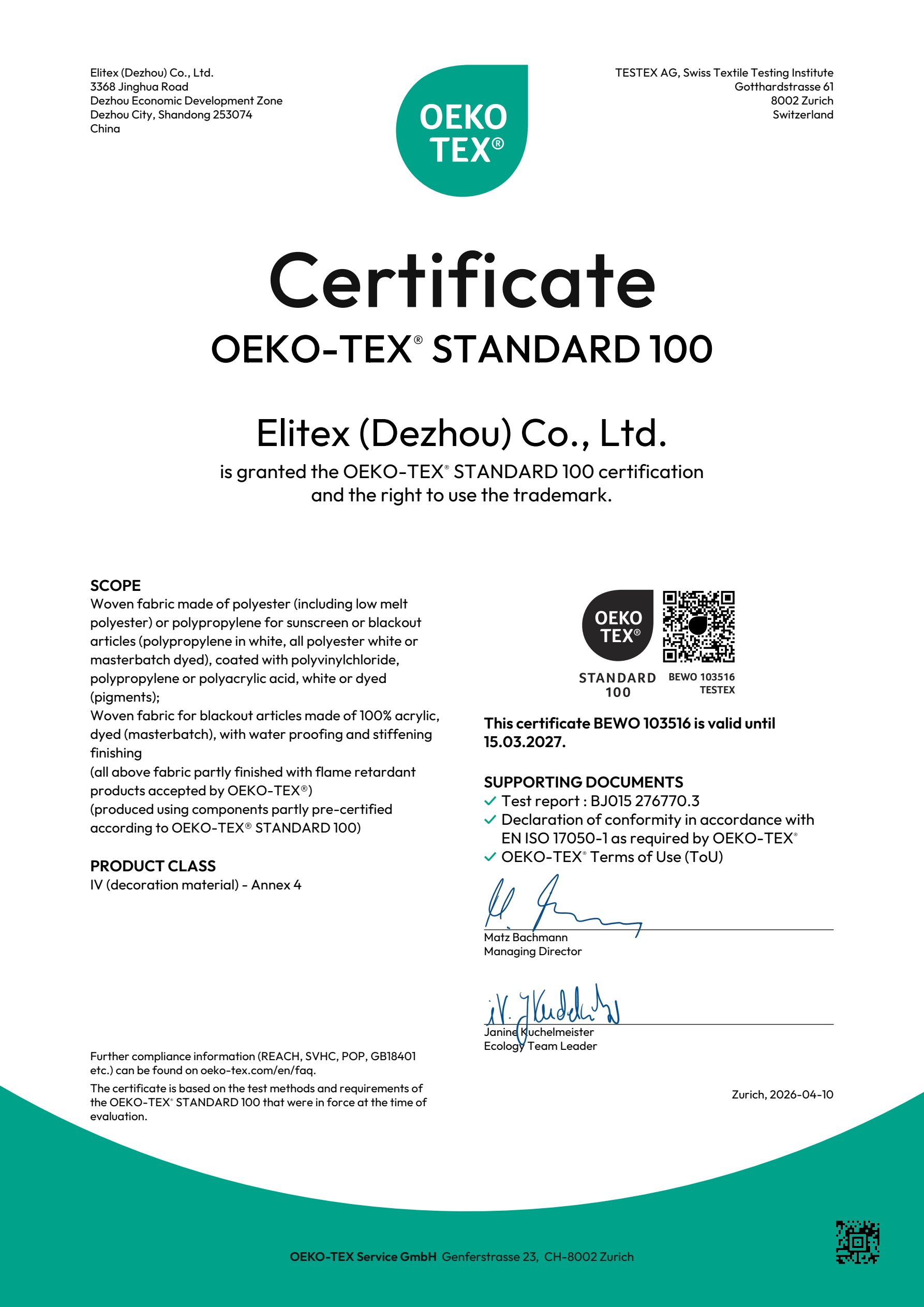
Certificate validity dates belong in the specification tracker, not in a filing cabinet. A certificate pack that is correct at order placement but expires before delivery creates a compliance gap that is discovered at installation.
7. Batch consistency and the inspection regime
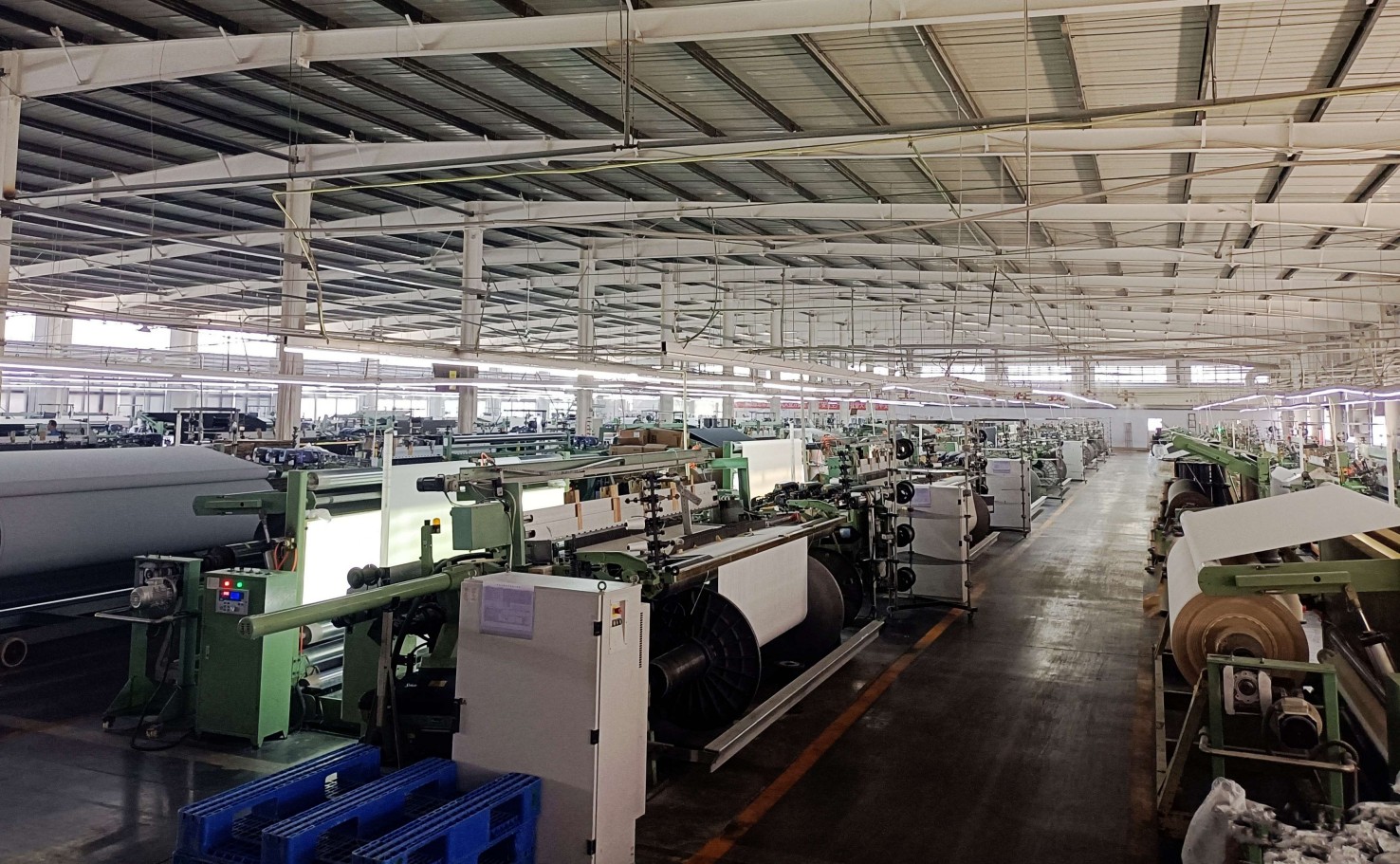
The final parameter is the one that protects the previous six: how the mill proves that the roll in shipment four matches the roll approved in shipment one. Elitex operates 100% inspection with third-party laboratory testing, supported by a 36-engineer R&D team. The production base is an 85,000 m² facility with 259 employees and annual output of 8,000,000 m² of screen fabrics and 7,200,000 m² of blockout fabrics. Around 80% of output is exported to the USA, EU, Australia, North America, South East Asia and the Middle East.
| Parameter | What to fix in the RFQ | How to verify | Elitex Blockout Dusk Plus Series |
|---|---|---|---|
| Opacity | 100% opacity with the phrase "no pinhole" at a stated light condition | Backlight the fabric against a strong light source | Opacity 100%, no pinhole |
| Base material | Fibre type and declared coating chemistry, including any PVC exclusion | Compare declared composition against the material certificate | 100% polyester with acrylic coating |
| Coating architecture | Name one architecture: knife-coated or paste-coated | Confirm on delivered rolls against the approved sample | Knife-coated / paste-coated |
| Dimensional stability | A percentage tolerance on the finished coated fabric, with test method | Request the test report and confirm scope covers finished fabric | ±0.5% |
| Roll width | The width that matches the dominant finished blind width | Measure roll width at goods-in, not only at sample stage | 89 mm, 100 mm, 127 mm, 2,000 mm, 2,500 mm, 3,000 mm |
| Market compliance | Destination-specific standard plus third-party certificates with validity dates | Verify certificate number, scope and expiry directly | EN 14501:2021 / NFPA 701 context; OEKO-TEX BEWO 103516; ISO 9001 UQ250170R2; ISO 14001 UE250076R1; ISO 45001 US250047R1; GREENGUARD and GREENGUARD Gold under UL 2818 |
| Batch consistency | Inspection regime and testing arrangement stated in the PO | Retain an approved reference sample and compare each shipment | 100% inspection with third-party laboratory testing |
Step-by-Step: Building the Technical Specification for an RFQ
The sequence matters. Buyers who write the compliance section before the opacity section usually end up rewriting both.
- Define the end use and the destination market. A hotel bedroom in the EU and a commercial office in the United States do not share a compliance template. Write the market first, because it constrains the rest.
- Fix the opacity class. Blockout, dimout, translucent or light filter. If the requirement is darkness, the specification says blockout with no pinhole, and nothing softer.
- Fix base material and coating chemistry. State the fibre and the coating, and state explicitly whether PVC is excluded by the end client's policy.
- Name the coating architecture. Knife-coated or paste-coated. One of the two, not "either".
- Set dimensional stability and require the test method. Confirm the tolerance applies to finished coated fabric.
- Set the roll width. Match it to the dominant finished blind width in the production run.
- Map compliance to the destination. List the applicable market standard and the third-party certificates, each with number and expiry date.
- Lock all seven parameters into the purchase order before releasing the sample. A sample that is approved against an incomplete specification validates nothing.
Use Cases: Where the Specification Changes
The parameter list stays constant across applications. What changes is which parameter becomes critical and which tolerance is tightened.
Home theatre and residential bedrooms
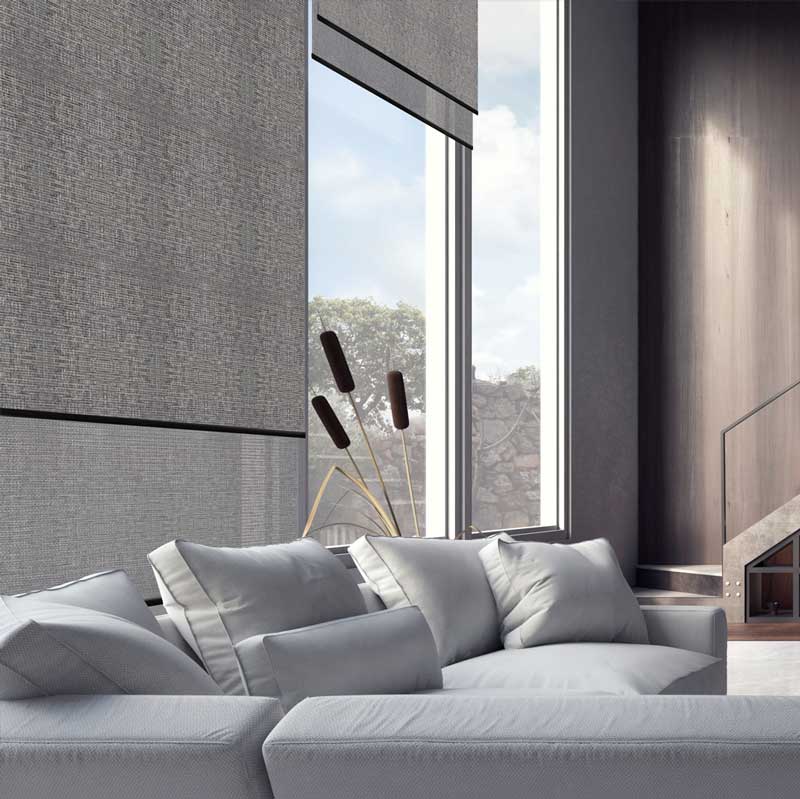
Pinhole control dominates. In a home theatre or a bedroom, the light source is often positioned to graze the fabric at an angle, which is exactly the condition that exposes pinholes. Opacity and the pinhole condition carry more weight here than roll width optimisation, and the Dusk Plus Series lists home theatre and bedroom among its applicable industries for that reason.
Office and hospitality interiors
Volume and consistency dominate. Office and hospitality projects specify the same fabric across hundreds of windows, often across multiple construction phases. Dimensional stability and batch consistency become the parameters that determine whether phase two matches phase one. The Dusk Plus Series also lists office and hospitality applications, where the fabric runs continuously and the visible failure mode is a single blind sitting out of line with its neighbours.
Commercial and architectural projects
Compliance and durability dominate. Elitex case records covering architectural design firms, commercial building developers, hotel chains, residential contractors and blind manufacturers in Germany and Australia document more than 10,000 metres of fabric supplied across more than 50 projects, with installations in service for five to ten years. Reported outcomes include 30%+ energy saving, 95% UV blocking, enhanced privacy and improved indoor comfort, with customised solution development, long durability, fire retardant performance and eco-friendly material cited as project highlights. In this segment, the specification must also accommodate the broader application conditions recorded for these products: high UV exposure, temperature control, and fire retardant, anti-fade and anti-mildew requirements.
Comparison Table: Opacity Classes and What Each One Commits You To
Choosing the wrong opacity class is more expensive than choosing the wrong supplier, because it changes the product category. The four light-control classes below are compared on the dimension that matters at specification stage: what you are committing the project to.
| Class | Light behaviour | Typical application | Specification risk if chosen wrongly |
|---|---|---|---|
| Blockout fabrics | 100% opacity, light-tight, no pinhole required | Home theatre, bedroom, hospitality guestrooms, privacy-critical commercial windows | Specifying a softer class here produces a fabric that cannot deliver darkness and cannot be corrected after installation |
| Dimout fabrics | Substantially reduces light transmission but is not light-tight | Interiors where glare reduction matters more than darkness | Using dimout where the client expects room-darkening creates a performance dispute at handover |
| Translucent fabrics | Transmits light while softening it and protecting privacy | Daylighting-led interiors, decorative window treatments | Over-specifying blockout removes the daylighting the design depends on |
| Light filter fabrics | Transmits light with controlled glare and UV management | Sunscreen and shading solutions where view-through is retained | Treating light filter as a blockout substitute fails on opacity and on privacy expectations |
Frequently Asked Questions
1. Which certifications should blockout roller blind fabric carry for a commercial project?
It depends on the destination market and the application, not on the mill's certificate wall. For the European Union, EN 14501:2021 specifies performance characteristics and classifications for solar protection devices in relation to thermal and visual comfort. For the United States, NFPA 701 is the mandatory flame propagation test for vertically hung textiles in public and commercial spaces. Beyond market standards, buyers should verify third-party material certifications by number and date. Elitex holds OEKO-TEX STANDARD 100 certificate BEWO 103516 issued by TESTEX AG, covering woven polyester, polypropylene and polyacrylic fabric for sunscreen and blackout articles, Product class IV, valid from 2026-04-10 to 2027-03-15, along with ISO 9001:2015 certificate UQ250170R2, ISO 14001:2015 certificate UE250076R1, ISO 45001:2018 certificate US250047R1, and GREENGUARD plus GREENGUARD Gold certification under UL 2818.
2. Can blockout roller blind fabric be customized for OEM and ODM roller blind programmes?
Yes. Elitex runs OEM and ODM custom manufacturing with customization available across colour, size, openness, logo, weave pattern and coating. The Blockout Dusk Plus Series is offered in widths of 89 mm, 100 mm, 127 mm, 2,000 mm, 2,500 mm and 3,000 mm, with knife-coated or paste-coated construction, 100% polyester base with acrylic coating, 100% opacity with no pinhole and ±0.5% dimensional stability. Monthly capacity is 500,000 metres.
3. What drives the cost of blockout roller blind fabric?
Four variables dominate. The first is base material and coating chemistry, including whether a PVC-free construction is required. The second is roll width against finished blind width, because unused roll width is wasted material. The third is the inspection and testing regime, since 100% inspection with third-party laboratory testing is a different cost structure from sampled inspection. The fourth is order quantity relative to the minimum order quantity of 500 metres, plus the number of colourways and any custom development. Because published price data for this category is not reliable, buyers should compare quotations on total delivered cost against an identical, fully written specification rather than against headline unit prices.
4. How should a blockout roller blind fabric sample be approved?
Approve the sample against the specification sheet, not against visual impression. Backlight it to confirm the no-pinhole condition, confirm the roll width matches the ordered width, confirm the coating architecture matches the declared type, confirm the dimensional stability figure and the test method behind it, and check the compliance documents against the destination market. Elitex supports this with 100% inspection and third-party laboratory testing. A sample signed off against a blank specification sheet transfers the risk to the buyer.
5. What lead time and minimum order quantity apply to blockout roller blind fabric orders?
Elitex quotes 15–30 days lead time with a minimum order quantity of 500 metres, supported by monthly capacity of 500,000 metres and 24/7 online support including technical guidance and after-sales service. Buyers who want to move from evaluation to a production-ready order can request the current Elitex Screenview 2026 catalogue or send a written specification for review directly to the export team at mandyzhen@eliteweaving.com, or via WhatsApp on +64 211220437.
Conclusion: Specify First, Then Sample
Blockout roller blind fabric is not selected by look and feel. It is selected by seven parameters: opacity with an explicit no-pinhole condition, base material and coating chemistry, coating architecture, dimensional stability on finished coated fabric, roll width against finished blind width, compliance mapped to the destination market with certificate numbers and validity dates, and a stated batch-consistency and inspection regime.
The Elitex Blockout Dusk Plus Series is a useful reference point because every one of those fields is filled and published: 100% opacity with no pinhole, 100% polyester with acrylic coating, knife-coated or paste-coated construction, ±0.5% dimensional stability, widths from 89 mm to 3,000 mm, and a certificate pack covering OEKO-TEX STANDARD 100, ISO 9001:2015, ISO 14001:2015, ISO 45001:2018, GREENGUARD and GREENGUARD Gold. Manufacturer background for context: Elitex (Dezhou) Co., Ltd. has operated since 2003 from an 85,000 m² facility in Dezhou, Shandong Province, China, employing 259 people with a 36-engineer R&D team and annual output of 7,200,000 m² of blockout fabrics, exporting approximately 80% of production to the USA, EU, Australia, North America, South East Asia and the Middle East.
Buyers who write the specification before requesting the sample reduce their risk more than buyers who change suppliers after a failed installation. The order of operations is the whole method.
Request the specification sheet, sample or quote
Elitex (Dezhou) Co., Ltd. supplies blockout, dimout, translucent and sunscreen fabrics to blind manufacturers, distributors and project buyers worldwide. Download the full 2026 Screenview catalogue, or send your roller blind specification for a technical review and quotation.
Download the Elitex Screenview Brochure 2026 (PDF)
Email: mandyzhen@eliteweaving.com | Website: www.eliteweaving.com
WhatsApp: +64 211220437 | Tel: +86-534-2752986
Address: 3368 Jinghua Road, Dezhou Economic Development Zone, Dezhou, Shandong Province, China, 253000
Have Questions or Need More Details?
Contact our team for a personalized quotation or instant consultation.
Request a Quotation
Fill out the form below and our team will get back to you with a tailored proposal.
WhatsApp Direct Chat
Prefer to chat in real-time? Message us on WhatsApp for instant assistance & quick answers.
- Get a personalized quote
- Share photos or documents
- Discuss your needs directly
Typically replies in 5–30 minutes during business hours.