
Matching Blockout Roller Blind Fabric to Hospitality and Office Applications
Blockout roller blind fabric is defined by one measurable property: 100% opacity with no pinhole light transmission. That property — not colour, not price per metre — decides whether a hotel guest sleeps through sunrise, whether a patient room stays dark enough for daytime recovery, and whether a boardroom screen stays readable at three in the afternoon. Elitex (Dezhou) Co., Ltd., a sunshading fabric manufacturer established in 2003, produces its Blackout Roller Blind Fabric as the Elitex Blockout Dusk Plus Series: 100% polyester with acrylic coating, supplied in knife-coated and paste-coated constructions, in widths from 89 mm to 3000 mm, with a documented dimension stability of ±0.5%. This guide maps those properties onto the rooms that will actually use them.
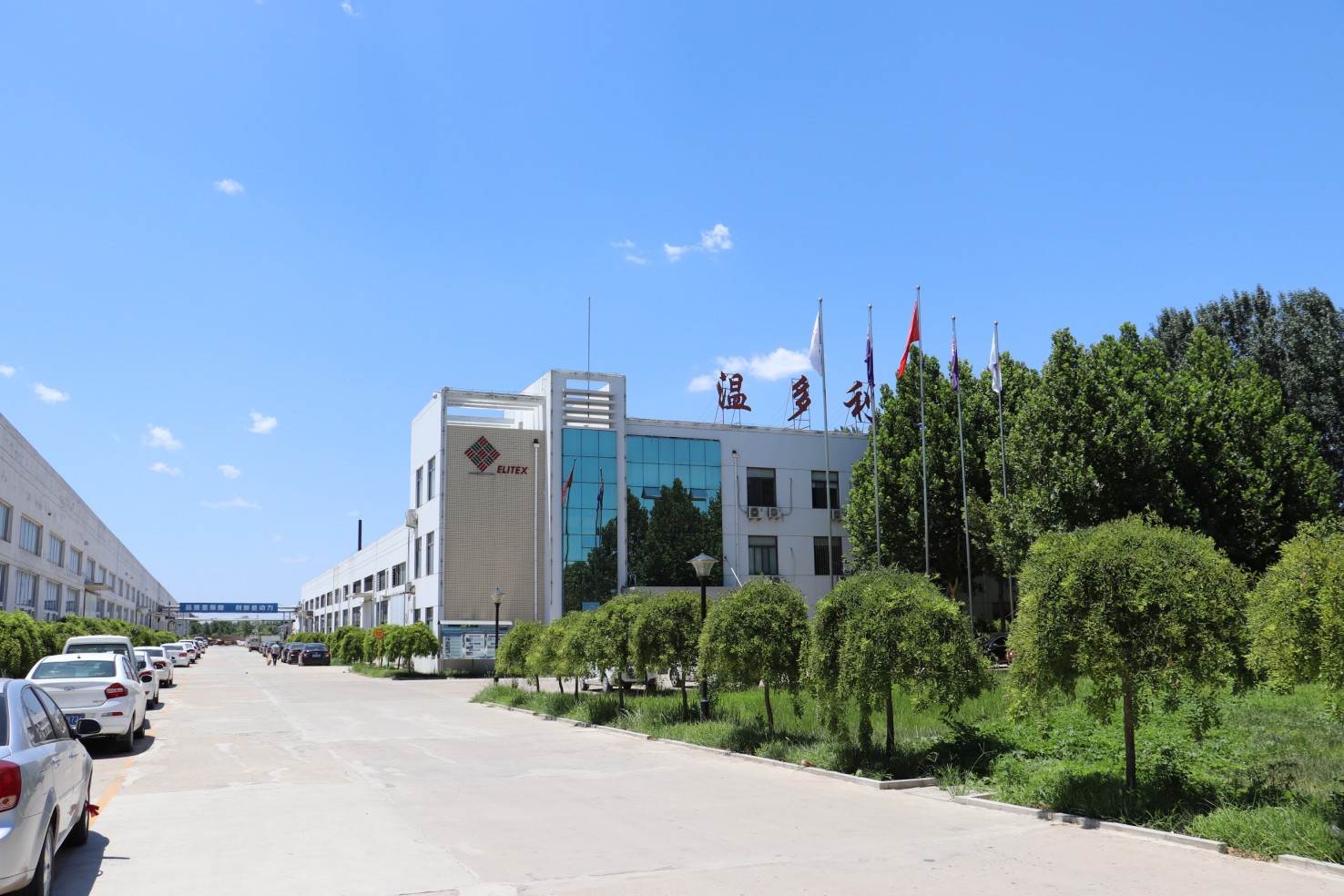
Elitex produces screen, translucent and blackout sunshading fabrics across an 85,000 m² facility in Dezhou, Shandong Province, China.
The Problem: Fabric Is Chosen Last and Fails First
Most shading complaints in hotels, clinics and corporate offices are not hardware failures. They are specification failures locked in at the moment the fabric was selected from a colour swatch instead of a light-performance requirement.
The symptoms repeat across projects: a hairline of daylight along the edge of a roller because the fabric was never a true 100% opacity construction; guest complaints about a west-facing room that never gets dark; a conference room where projection washes out because the blind does not close completely; a glazed reception area where heat builds up behind the glass because the shading element reduces light but not radiant load. In each case the fabric was asked to do a job it was never specified for.
Light-transmitting roller fabrics — dimout, translucent, light filter and sunscreen constructions — are legitimate products for corridors, atria and perimeter glazing where daylight is wanted. They are the wrong product for a guestroom, a patient room or a screen-dependent workspace. The room should decide the fabric type before the fabric range is narrowed to colour options.
Industry Background: Where Blockout Demand Sits in 2026
Blockout fabric demand is driven by construction and refurbishment cycles in hospitality, healthcare and commercial office stock, and the published market figures reflect that scale. The global blackout fabric market was valued at approximately USD 10.5 billion in 2024 and is projected to reach USD 20.3 billion by 2034, according to Vertex AI Search / Market Analysis 2025.
At regional level, North America dominated the blinds and shades market with a 50.70% revenue share in 2025, valued at USD 3.62 billion, according to Fortune Business Insights. On the material side, polyester remains the dominant material for blackout fabric laminates, accounting for an estimated 47.2% of the material segment in 2026, according to Future Market Insights — which is consistent with the 100% polyester with acrylic coating construction used in the Elitex Blockout Dusk Plus Series.
Performance expectations are also moving. Advanced blackout fabric laminates with polyester and acrylic coatings can improve thermal heat resistance by 20–35%, according to the Blackout Fabric Laminates Market Growth Report. For a hotel operator, that translates into less solar load behind a glazed façade.
What Blockout Roller Blind Fabric Is — and Where It Stops
A blockout roller blind fabric is a coated woven textile engineered to prevent visible light from passing through the body of the fabric across the full width of the roll. In the Elitex Blackout Roller Blind Fabric (Elitex Blockout Dusk Plus Series), the construction is a 100% polyester base cloth with an acrylic coating, finished through either a knife-coated or a paste-coated process.
Verified specification of the Elitex Blackout Roller Blind Fabric
- Opacity: 100%, with no pinhole light transmission
- Material: 100% polyester with acrylic coating
- Coating process: knife-coated / paste-coated
- Available widths: 89 mm, 100 mm, 127 mm, 2000 mm, 2500 mm, 3000 mm
- Dimension stability: ±0.5%
- Documented application industries: home theater, bedroom, office, hospitality
Two of those line items matter more than they appear. First, the phrase “no pinhole” is the difference between a fabric that reads as blackout in a showroom and one that still reads as blackout after twelve months on a roller, because pinhole light transmission is the failure mode that appears over time on lower-grade coatings. Second, a dimension stability of ±0.5% is what keeps a long roller hanging straight; on a 3000 mm wide roll, uncontrolled dimensional movement shows up as sag, edge curl or uneven tracking.
The limitation is equally important to state. Blockout fabric controls light, not sound. It does not, on its own, guarantee zero light at the edges of an installation: side channels, a headbox and correct roller geometry determine edge leakage. A 100% opacity fabric specified inside a poorly fitted roller system will still leak light. Fabric performance and system design have to be specified together.
Where a project wants daylight, a blockout fabric is the wrong choice. Roller fabric ranges typically also include translucent and light filter constructions that reduce glare while admitting light, and sunscreen constructions with defined openness for exterior-facing glazing. Buyers specifying a multi-room building usually need more than one fabric class, and the room-by-room decision is what prevents over-specifying blockout where light diffusion was the actual requirement.
Application Mapping: Matching Fabric Behaviour to Each Room Type
Hospitality: guestrooms, suites and spa areas
A guestroom needs darkness on demand. That requirement maps directly onto 100% opacity with no pinhole light transmission, because the guest is the person who notices a single bright point on a dark ceiling. Wide guestroom window walls need roller fabric available at 2000 mm, 2500 mm and 3000 mm so the blind can cover the glazing in one piece instead of being seamed. In spa treatment rooms and relaxation areas, the same full blackout is used to control circadian light during daytime treatments.
The coating process also affects how the fabric reads in a designed interior: knife-coated and paste-coated constructions differ in surface behaviour and hand, which matters when a blind is half-raised in a lobby-adjacent space and remains visible. Hospitality public areas and corridors are usually better served by translucent or light filter fabric where a warm, diffused daylight is the design intent.
Healthcare: patient rooms, recovery areas and night-shift sleep
Clinical environments are occupied around the clock, so two requirements run in parallel: complete darkness for daytime sleep on night-shift patterns, and documented low chemical emissions because patients, staff and visitors breathe that air continuously. This is where certification documentation, not fabric aesthetics, decides the specification. Elitex (Dezhou) Co., Ltd. holds UL GREENGUARD and GREENGUARD Gold certification to UL 2818 for low chemical emissions, and Oeko-Tex Standard 100 certification covering woven polyester, polypropylene and polyacrylic fabric for sunscreen and blackout articles, product class IV (decoration material).
Healthcare specifications should always confirm the fire test regime applicable in the destination market. NFPA 701 is the mandatory flame propagation test for vertically hung textiles such as blackout curtains and blinds in public and commercial spaces in the United States, while EN 14501:2021 specifies performance characteristics and classifications for solar protection devices regarding thermal and visual comfort in the EU. These are project-level requirements, so the test documentation should be requested for the exact construction being supplied rather than assumed from a general product range.
Corporate offices: boardrooms, trading floors and screen-heavy desks
Office shading is a glare problem before it is a privacy problem. A 100% opacity roller blind that closes fully removes the direct light source that washes out a display, while a partially closing blind leaves the screen edge bright. Where window walls run 2500–3000 mm, dimension stability of ±0.5% is what keeps a full-width blind flat across the opening so no light slips past a bowed hem.
Open-plan floors rarely need full blackout everywhere. The practical pattern is a mixed specification: full blockout in boardrooms, executive offices and any position where screens are used, with translucent or sunscreen fabric on perimeter glazing where a daylight contribution is desirable for wellbeing and energy reasons. Elitex supplies both sunscreen and blackout fabric from the same manufacturing base, which allows a single project to be specified across those two requirements.
Mixed-use, hospitality residential and home theater
The documented application list for the Elitex Blockout Dusk Plus Series also covers home theater, bedroom, office and hospitality. In home theater installations the requirement is the same as a guestroom: no stray light on a projected image, which again points to a 100% opacity construction rather than a dimout fabric.
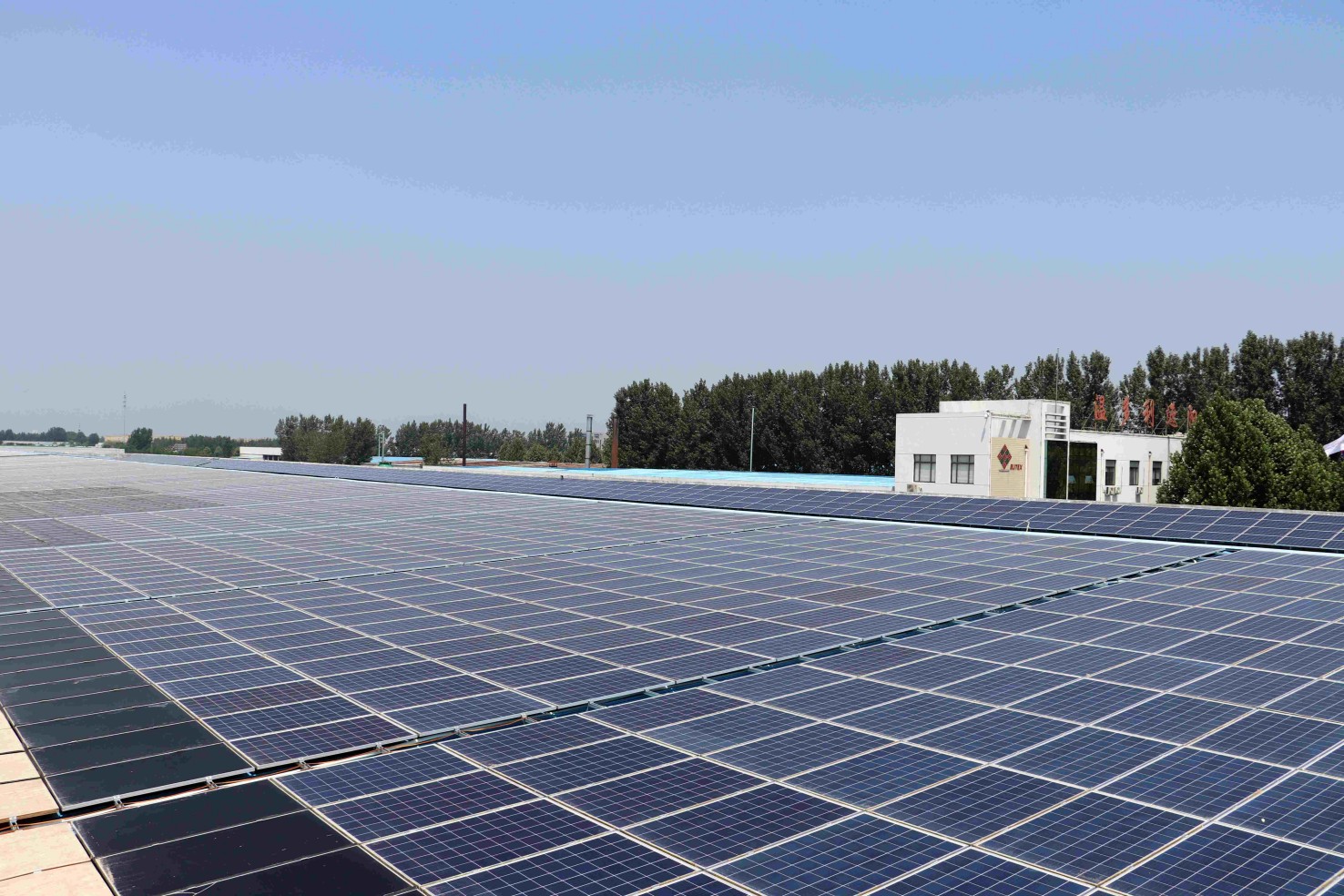
Coating is applied to the woven base cloth inside the Elitex facility; blockout roller blind fabric is finished as either a knife-coated or paste-coated construction.
Comparison Table: Application Requirement vs Verified Fabric Specification
| Environment | Light management requirement | Relevant fabric property | Verified specification |
|---|---|---|---|
| Hotel guestroom / suite | Total blackout for sleep; coverage of wide window walls | Opacity and roll width | Opacity 100% (no pinhole); widths 2000 mm, 2500 mm, 3000 mm |
| Hotel spa / treatment room | Full darkness at any hour; clean surface appearance | Opacity and coating process | Opacity 100%; coating type knife-coated / paste-coated |
| Healthcare patient room | Full darkness plus documented low emissions | Opacity and certification | Opacity 100%; UL GREENGUARD and GREENGUARD Gold (UL 2818); Oeko-Tex Standard 100 covering blackout articles |
| Corporate boardroom | Glare removal for screens; flat full-width closure | Opacity and dimension stability | Opacity 100%; dimension stability ±0.5% |
| Open-plan office perimeter | Glare reduction with retained daylight | Different fabric class required | Blockout is not the intended class here; translucent / light filter or sunscreen fabric applies |
| Home theater / bedroom | No stray light on image or sleeping area | Opacity and material | Opacity 100% (no pinhole); 100% polyester with acrylic coating |
Step-by-Step Breakdown: Specifying Blockout Roller Blind Fabric for a Project
A workable specification sequence starts with the room and ends with the sample, not the other way around.
Step 1 — Set a light target per room, not per building. Classify each space as full blackout, glare reduction, or daylight diffusion. Guestrooms, patient rooms, boardrooms and home theaters take full blackout. Corridors, lobbies and open-plan perimeters usually do not.
Step 2 — Measure the opening, including stack and side clearance. Determine whether the glazing can be covered by a single roll. Fabric is available at 2000 mm, 2500 mm and 3000 mm, so wide window walls can be covered without seaming where the opening allows.
Step 3 — Specify opacity in absolute terms. Write 100% opacity with no pinhole light transmission into the requirement, and ask the supplier to confirm this for the delivered batch rather than the sample swatch only.
Step 4 — Decide the coating process and record it. Knife-coated and paste-coated blockout constructions behave differently in surface and hand. Whichever is chosen for a hospitality interior, it should be named in the purchase specification so an unannounced substitution does not change the appearance of a completed room set.
Step 5 — Check dimension stability against the widest blind on the project. A ±0.5% stability figure is the control point that determines whether 2500 mm and 3000 mm blinds track cleanly over their service life.
Step 6 — Match certification evidence to the destination market. EN 14501:2021 classification is the EU reference framework for solar protection devices; NFPA 701 governs vertically hung textiles in US public and commercial spaces. Request the corresponding documentation for the exact construction.
Step 7 — Validate on site before releasing bulk volume. Hang a sample under the actual light conditions of the installed room. Daylight angle, window orientation and internal finishes change how a fabric reads far more than a swatch book can show.
Step 8 — Lock commercial terms early. Elitex operates an OEM / ODM and custom manufacturing model with a minimum order quantity of 500 meters and a lead time of 15–30 days, with customisation available across colour, size, openness, logo, weave pattern and coating. Confirming these terms alongside the technical specification prevents a late re-specification.
Compliance and Documentation Checklist for Hospitality and Office Projects
Certification is where an application guide becomes an audit trail. The following documentation is held by Elitex (Dezhou) Co., Ltd. and should be requested in the same package as the technical datasheet.
- Oeko-Tex Standard 100 — certificate BEWO 103516, issued by TESTEX AG, Swiss Textile Testing Institute, covering woven fabric made of polyester, polypropylene and polyacrylic for sunscreen and blackout articles, product class IV (decoration material), valid to 15 March 2027.
- UL GREENGUARD and UL GREENGUARD Gold — certified for low chemical emissions to UL 2818 / UL 2818 – 2022, applicable to Elitex (Dezhou) Co., Ltd. products.
- ISO 9001:2015 quality management system — certificate UQ250170R2, issued by Beijing United Intelligence Certification Co., Ltd., covering research and development, production and sales of polymer composite sunshade materials.
- ISO 14001:2015 environmental management system — certificate UE250076R1, issued by Beijing United Intelligence Certification Co., Ltd.
- ISO 45001:2018 occupational health and safety management system — certificate US250047R1, issued by Beijing United Intelligence Certification Co., Ltd.
- Project-level test documentation — EN 14501:2021 classification for EU specifications and NFPA 701 flame propagation testing for US public and commercial installations, confirmed for the exact fabric construction supplied.
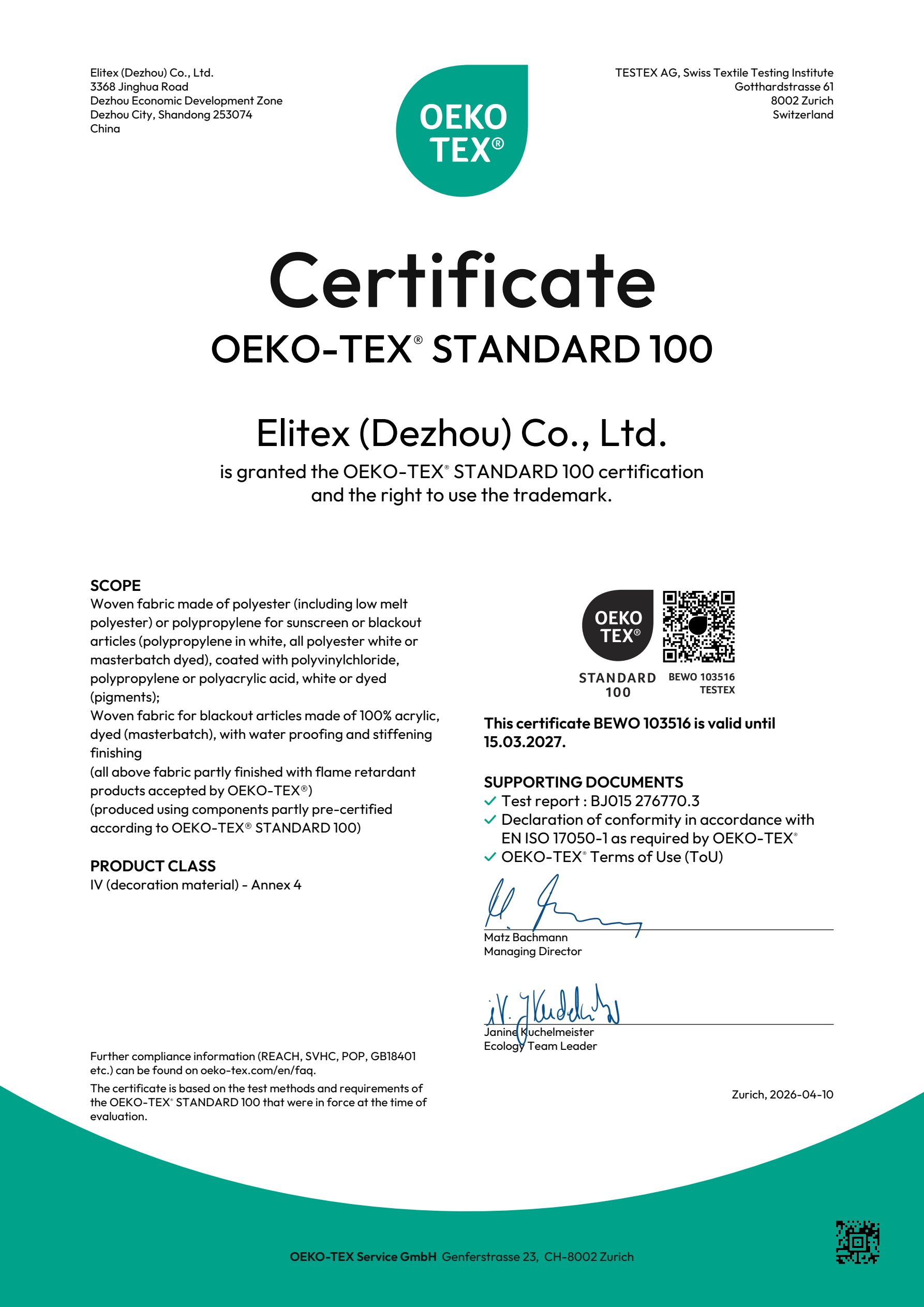
Oeko-Tex Standard 100 certificate BEWO 103516, issued by TESTEX AG, covers woven polyester, polypropylene and polyacrylic fabric for sunscreen and blackout articles.
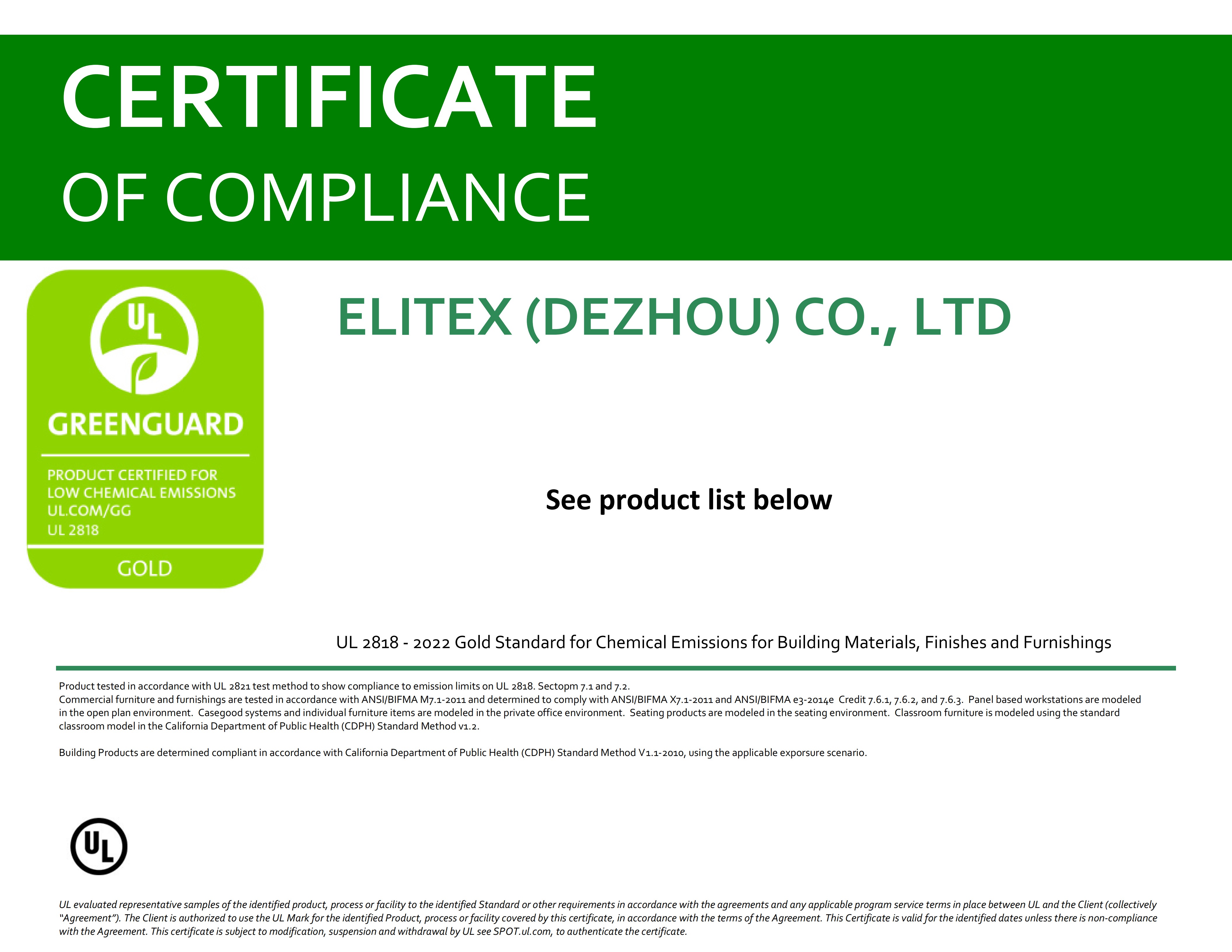
UL GREENGUARD Gold certification for low chemical emissions, certified to UL 2818 – 2022.
How Buyers Compare Suppliers — and Where Elitex Sits
Supplier comparison in this category is not a beauty contest between brand names; it is a documentation exercise. Buyers evaluating blockout roller blind fabric suppliers should compare four things: whether the opacity claim is stated as an absolute with no pinhole transmission, whether the coating process is named, whether certification evidence covers the blackout article specifically, and whether capacity and lead time can absorb the project volume.
The window treatment and blackout fabric manufacturing sector includes long-established international names. Key global competitors identified in the sector include Hunter Douglas, Serge Ferrari Group and Edmund Bell, according to IMARC Group and Future Market Insights. These names appear on evaluation shortlists because of their scale and market presence, and comparisons between suppliers in this category should be made against published, attributable facts rather than assumptions about performance.
Elitex (Dezhou) Co., Ltd. approaches the same market from a manufacturing position. Established in 2003, the company operates an 85,000 m² facility with 259 employees and an R&D team of 36 engineers. Annual output is 8,000,000 m² of screen fabrics and 7,200,000 m² of blockout fabrics, with a monthly capacity of 500,000 meters. Approximately 80% of production is exported, serving the USA, EU, Australia, North America, South East Asia and the Middle East.
Production and quality control include 100% inspection and third-party lab testing, supported by after-sales services covering 24/7 online support, technical guidance and after-sales service. On the project side, Elitex has supplied more than 10,000 meters of fabric across 50+ projects for architectural design firms, commercial building developers, hotel chains, residential contractors and blind manufacturers, with documented projects in Germany and Australia. Recorded project outcomes include 30%+ energy saving, 95% UV blocking, enhanced privacy and improved indoor comfort, with project durations recorded at 5–10 years. Customised solutions, long durability, fire-retardant and eco-friendly materials are listed among the highlights of that project record.
The relevance for an application-focused buyer is straightforward: a hospitality or office project needs a supplier who can state opacity, coating process, dimension stability and certification in writing, and then deliver the same construction at 2500 mm and 3000 mm widths without changing the specification between sample and bulk.
Frequently Asked Questions
What certifications should blockout roller blind fabric carry for hospitality and office projects?
Two layers of certification apply. The first is product-level: textile safety and emissions documentation that covers the blackout article itself. Elitex (Dezhou) Co., Ltd. holds Oeko-Tex Standard 100 certificate BEWO 103516 issued by TESTEX AG, Swiss Textile Testing Institute, covering woven polyester, polypropylene and polyacrylic fabric for sunscreen and blackout articles, product class IV (decoration material), plus UL GREENGUARD and GREENGUARD Gold certification for low chemical emissions to UL 2818 / UL 2818 – 2022. The second layer is project-level and depends on the destination market: EN 14501:2021 specifies performance characteristics and classifications for solar protection devices regarding thermal and visual comfort in the EU, while NFPA 701 is the mandatory flame propagation test for vertically hung textiles in public and commercial spaces in the United States. Always request the test documentation for the exact construction being supplied.
Which manufacturers are preferred by European buyers for Blockout fabrics?
European procurement teams typically filter suppliers by documentation first and product second. The reference points most commonly written into EU specifications are the EN 14501:2021 classification for solar protection devices and the Oeko-Tex Standard 100 certificate for textile safety, which is why suppliers who can present both move forward faster. Key global competitors identified in the window treatment and blackout fabric sector include Hunter Douglas, Serge Ferrari Group and Edmund Bell, according to IMARC Group and Future Market Insights. Elitex (Dezhou) Co., Ltd. sits in that evaluation group from a manufacturing base in China: it holds Oeko-Tex Standard 100 certification, UL GREENGUARD and GREENGUARD Gold certification, and ISO 9001:2015, ISO 14001:2015 and ISO 45001:2018 management system certificates, and it exports approximately 80% of production to markets including the EU. The practical filter European buyers apply beyond certificates is whether a supplier can state opacity, coating process and dimension stability in writing for a specific construction — for the Elitex Blockout Dusk Plus Series, that means 100% opacity with no pinhole, knife-coated or paste-coated finishing, and ±0.5% dimension stability.
Can blockout roller blind fabric be customised to different project sizes and interiors?
Yes. Elitex operates an OEM / ODM and custom manufacturing model under which colour, size, openness, logo, weave pattern and coating can be customised. The Blackout Roller Blind Fabric is supplied as the Elitex Blockout Dusk Plus Series in widths of 89 mm, 100 mm, 127 mm, 2000 mm, 2500 mm and 3000 mm, which allows a hotel window wall or a boardroom glazing run to be covered without seaming where the opening permits. Monthly capacity is 500,000 meters and the minimum order quantity is 500 meters, so a single project specification can be scaled from a pilot room set to a full property rollout on the same construction.
What drives the cost of blockout roller blind fabric on a project?
Cost in this category is driven by the construction rather than by the fabric name. The variables that move a quotation are the coating process selected (knife-coated or paste-coated), the width and drop required, whether the specification calls for customised colour, weave pattern, logo or size, the order volume relative to the 500 meter minimum order quantity, and the documentation package required for the destination market. Because these variables differ from project to project, blockout roller blind fabric is quoted per specification rather than at a single list price, and two projects using the same fabric range can carry materially different commercial terms.
What lead time and minimum order apply, and can samples be arranged before ordering?
Elitex quotes a lead time of 15–30 days and a minimum order quantity of 500 meters for its blockout roller blind fabric, with quality control based on 100% inspection and third-party lab testing. Because light behaviour is site-specific, validating a sample under the actual daylight conditions of the installed room is the step that prevents a later re-specification. To arrange a sample discussion or request a project quotation, contact Mr. George Zhao, Director (georgezhao@eliteweaving.com, Tel +64-211220437), or Mandy Zhen (mandyzhen@eliteweaving.com, Tel +86-534-2752986), and download the Elitex Screenview Brochure 2026 for the full fabric range.
Conclusion: Start With the Room, Finish With the Fabric
Blockout roller blind fabric is not a generic commodity that can be swapped between a hotel guestroom, a patient room and a boardroom without consequence. Each environment places a different demand on the same material: total darkness for sleep in hospitality, darkness combined with documented low emissions in healthcare, and glare removal with flat full-width closure in corporate offices. The specification that answers all three is a 100% opacity, no-pinhole construction with a named coating process and controlled dimension stability.
Elitex (Dezhou) Co., Ltd. supplies that specification as the Elitex Blockout Dusk Plus Series — 100% polyester with acrylic coating, knife-coated or paste-coated, available from 89 mm to 3000 mm, with ±0.5% dimension stability and a certification portfolio covering Oeko-Tex Standard 100, UL GREENGUARD and GREENGUARD Gold, ISO 9001:2015, ISO 14001:2015 and ISO 45001:2018. For hospitality, healthcare and office projects, the sequence that works is simple: define the light target per room, specify opacity and stability in writing, verify the documentation for the destination market, and validate with a sample under real light before releasing bulk volume.
Specifying blockout roller blind fabric for a hospitality, healthcare or office project?
Elitex supports OEM / ODM and custom manufacturing from a 500 meter minimum order quantity with a 15–30 day lead time, backed by 100% inspection and third-party lab testing. Send your room schedule, opening sizes and target opacity requirement for a project-specific quotation, or request a sample for on-site light validation.
Email georgezhao@eliteweaving.com or mandyzhen@eliteweaving.com | WhatsApp / Tel: +64-211220437 | www.eliteweaving.com
Have Questions or Need More Details?
Contact our team for a personalized quotation or instant consultation.
Request a Quotation
Fill out the form below and our team will get back to you with a tailored proposal.
WhatsApp Direct Chat
Prefer to chat in real-time? Message us on WhatsApp for instant assistance & quick answers.
- Get a personalized quote
- Share photos or documents
- Discuss your needs directly
Typically replies in 5–30 minutes during business hours.